



Success stories are the first thing most people look for before a drug test, and they are also the least reliable thing you can find. A story tells you that one person passed once. It does not tell you their test type, their usage history, their hair, their lab or their cutoff. This guide shows you how to read these stories, what the science says about hair, urine and saliva tests, and how we at Passusa help people prepare, with a focus on hair follicle tests and our Macujo Aloe Rid Shampoo.
TL;DR
- A success story is one data point. Test type, detection window, cutoff level and the person’s own body decide the outcome more than any single product.
- Scalp hair tests look back about three months, so a month of waiting does not necessarily clear you.
- Peer-reviewed work shows that some shampoos and hair treatments can lower THC levels in hair, but results vary and nothing is guaranteed.
- Urine and saliva tests have much shorter windows, so timing and validity matter more than any trick.
- We offer the Macujo Method, a wash calculator and unlimited private consultations until you pass, so you are not guessing alone.
Table of Contents
- Why drug test stories are everywhere and why they mislead
- What a hair test actually measures
- What research says about shampoos and hair treatments
- A realistic hair test prep scenario
- How Macujo Aloe Rid Shampoo fits into hair preparation
- Urine and saliva tests: a different clock
- Our perspective on success stories
- If a result looks wrong
- Warning signs in any success story or product page
- Frequently asked questions
- Sources
Why drug test stories are everywhere and why they mislead
Search for stories and you will find three kinds. There are personal accounts from people who passed, forum jokes about wild workarounds, and cautionary tales from people who failed or were wrongly flagged. All three are real human experiences. None of them is a controlled comparison.
The problem is what statisticians call survivorship bias. People who passed tend to post “it worked.” People who failed often stay quiet, or blame the wrong thing. A person who passed after using a product may also have passed because they had stopped using weeks earlier, had light exposure, or had a test with a high cutoff. The product gets the credit.
Here is a quick way to judge any story you read:
- Which test was it? Hair, urine and saliva work on completely different timelines.
- What substance and how often? One occasional use and daily use for years are different situations.
- How much time passed? A story that skips this detail is not usable.
- What was the exact method? “I washed a lot” is not a protocol.
- Who is telling it? Sellers, anonymous forum accounts and people who passed by chance all sound the same on a screen.
We would rather you treat our own testimonials the same way. Use them as a signal that real people have gone through this, then rely on the facts of your own test.
What a hair test actually measures
Before you judge any method, you need to know what the lab is looking at. Hair tests do not measure how impaired you are. They look for drugs or their metabolites that were deposited in the hair as it grew.
According to Cleveland Clinic, scalp hair has a three-month detection window, while slower-growing body hair may cover up to 12 months, and results vary with hair characteristics. A 2025 comparison from a toxicology company adds that hair testing is aimed at historic use over roughly 90 days, with a lag of up to 14 days before use shows up.
That answers a common question: is one month long enough? Not necessarily. If your employer orders a head hair test, a month of abstinence leaves most of the 90-day window still in your hair. Body hair is a different story, and we cover site selection and the longer window in our guide to body hair drug tests.
Two more points matter for how you read stories:
- Cutoffs decide positives. NIDA explains that tests detect drugs or metabolites above predetermined cutoffs. For the federal workplace urine cannabis screen, that line is 50 ng/mL, so a result under it is reported negative even if it is above zero. Our page on SAMHSA cutoff levels walks through the 50/15 ng/mL numbers.
- Environmental exposure is a known issue. The National Institute of Justice notes that analyzing metabolites in hair may help distinguish use from environmental contamination, while also admitting limits in the reference data. So the science of hair testing is still evolving.
If you want the practical side of hair tests and marijuana specifically, see our page on the hair follicle drug test for marijuana.
What research says about shampoos and hair treatments
This is the part success stories cannot answer: does washing hair actually change a result? The honest answer is that it can, to a degree that varies.
A 2022 peer-reviewed study on THC in hair looked at 54 THC-positive samples. It found mean concentration reductions of 52% with a commercial shampoo and 65% with a disinfectant, and some treatments pushed THC below detectability. The authors urged caution when interpreting quantitative hair results, which tells you labs know this is possible.
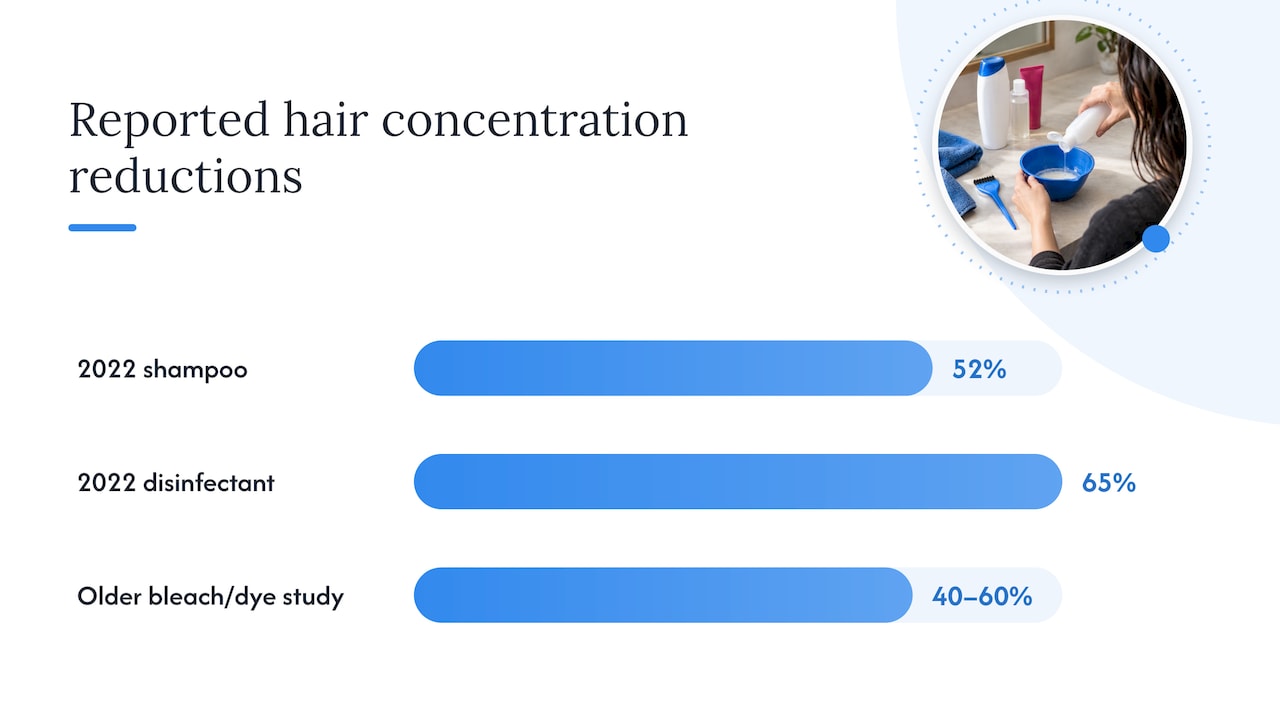
Older work points the same way. A study of cosmetic treatment found that bleaching or dyeing lowered drug concentrations, commonly by about 40% to 60% for several compounds including THC-COOH, with bleaching causing larger drops than dyeing.
The picture is not one-sided, and we will not pretend it is. A 2023 review notes that detox shampoo studies are mixed: some found decreases for some drugs, while one found no significant change in EtG after a single manufacturer-directed application. The same review says standardized routine detection of extensive washing or cleansing-shampoo treatment is not currently available. And some addiction-treatment publishers state that little research backs detox-kit guarantees.
What we take from all this:
- Washing and cleansing can lower what is in the hair, so the idea is not a myth.
- A single wash is a weak plan. Repeated, consistent treatment is what the stronger results involve.
- Your baseline matters. Heavy, long-term use leaves more to reduce than light use.
- Nobody can honestly promise a result from a bottle alone. That is why we pair products with a method and support.
A realistic hair test prep scenario
The following is an illustrative scenario, not a customer testimonial. We use it to show what a sensible preparation looks like.
Imagine a job applicant who gets a conditional offer and is told to report for a hair collection within a few days. They have used cannabis occasionally in the past few months. They are not sure whether the employer tests head or body hair, and they have never prepared for this.
A sensible sequence looks like this:
- Stop use right away. New use keeps adding to the hair that grows.
- Find out the test type. Ask the employer or the collection site whether it is a hair panel, and what hair they take.
- Build a wash schedule around the real deadline. Timing, hair length and wash frequency drive how many treatments are practical. This is what our Macujo wash calculator is for.
- Keep the routine consistent. Skipping treatments in the final days defeats the point.
- Have a plan if something goes wrong. Know your right to a confirmatory test and a review by a medical review officer (more below).
Notice that nothing in that list is a magic trick. The people who tell the best success stories usually did the boring parts well.
How Macujo Aloe Rid Shampoo fits into hair preparation
Our main focus at Passusa is hair follicle preparation, and the Macujo Aloe Rid Shampoo is the centerpiece of the Macujo Method. It is designed to be used as part of a structured wash routine to help cleanse hair of toxins before a hair follicle test. We do not claim it works the same for every person, and we do not hide that hair tests are the hardest to prepare for, because the detection window is the longest.
What the Method adds on top of the shampoo:
- A wash calculator that helps you plan how many washes you need based on your timeline.
- Step-by-step video instructions so you do not improvise the routine.
- Test-specific guidance, since a head hair test and a body hair test call for different thinking.
- Unlimited private consultations until you pass, which is the heart of our support promise.
If you want to read before you buy, start with our guides on how to pass a hair follicle drug test, the difficulties of hair follicle tests and the basics of drug testing by hair follicle. If you are in a regulated situation, such as probation, read probation drug test preparation. For employer rules by state, see how pre-employment drug test laws shape the hair-first approach.
Ready to prepare
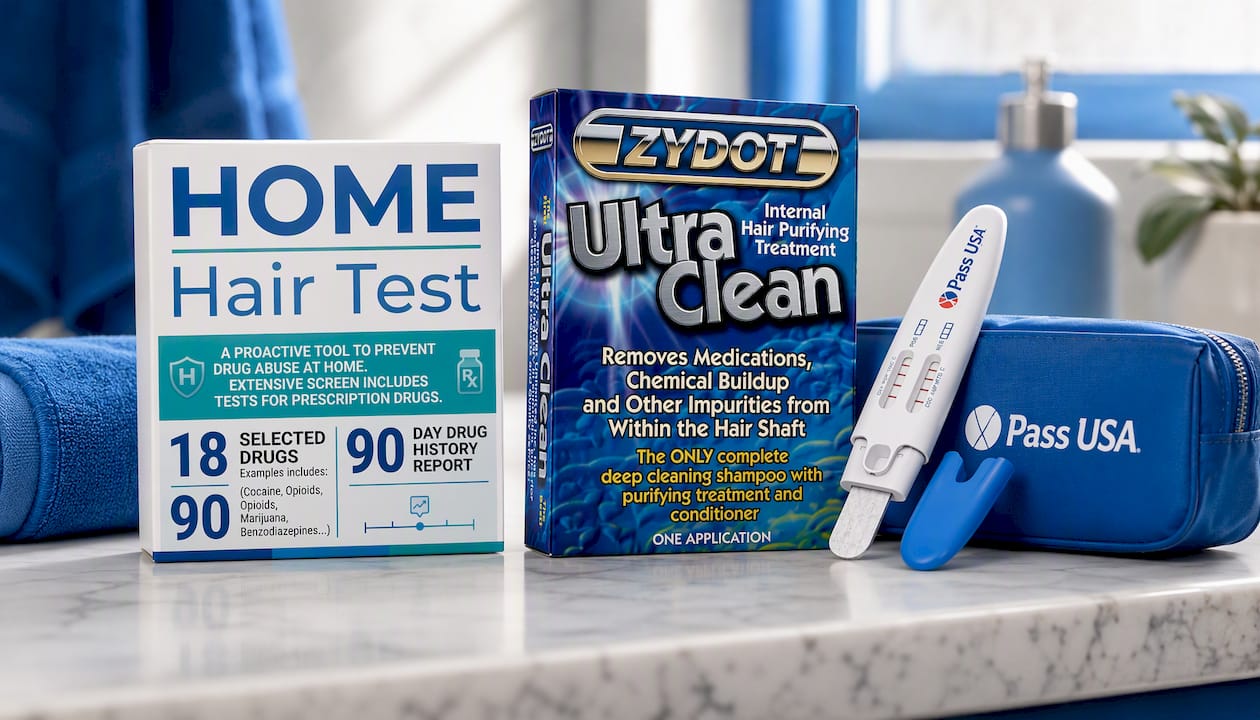
You can browse our hair, urine and saliva products on the Passusa store, including the Zydot Ultra Clean Shampoo for hair purifying treatment. If you would rather have someone build the plan with you, book a private consultation with Mike Macujo. If you are not sure whether you will even be tested on hair, an at-home hair follicle test kit lets you check privately first.
Urine and saliva tests: a different clock
Hair gets most of our attention, but urine is the specimen you are most likely to face. Cleveland Clinic describes urine drug testing as the most common type, commonly screening for alcohol, amphetamines, benzodiazepines, opioids, cocaine and THC.
The window is far shorter than for hair. The 2025 toxicology comparison says most drugs are detectable in urine for about two to three days at common workplace cutoffs, with cannabinoids commonly one to four days. Heavier or longer-term use can stretch that, so treat those numbers as a general range.
Two practical points for urine:
- Validity matters as much as concentration. Federal-style laboratory testing checks whether a specimen is positive, adulterated, substituted, invalid or dilute, according to SAMHSA’s 2024 MRO manual. A clever idea that produces an invalid sample is not a pass. Our guide to how labs judge urine validity covers temperature and other red flags.
- Dilution is not a plan. A very clear sample can draw attention rather than avoid it.
For saliva, the window is shorter still, and the test is usually a swab collected under observation. We carry oral fluid saliva tests so you can screen yourself, plus mouthwash and other saliva products for situations that call for them. Our urine range includes drinks, teas and kits, matched to your timeline and the type of test.
Our perspective on success stories
We have been helping people through drug tests for more than 20 years, and we have read thousands of messages from customers. Here is what we have learned.
The people who feel most confident are rarely the ones who found the cleverest trick. They are the ones who knew exactly which test they faced, counted the days honestly, and followed a consistent routine. The people who struggle are usually the ones who found out the test type late, started late, or changed the plan halfway.
We also believe in telling customers where the limits are. Hair tests are the hardest, because the window is the longest and the science of washing is still mixed. That is exactly why we built the Macujo Method around planning and support instead of a single bottle, and why we stay with you through unlimited consultations until you pass. A product is a tool. A plan and someone to check it with is what makes the tool work.
— Detox Experts
If a result looks wrong
Success stories rarely cover the other side: people who did not use drugs, or who believe a result is mistaken. The Brittany Tucker case, reported in news coverage of a hair follicle test that flagged drugs she says she never took, shows why you should know your options.
Here is what official sources say you can do:
- An initial screen is presumptive. NIDA explains that confirmatory gas or liquid chromatography and mass spectrometry testing is more specific and can verify or refute it. We explain the lab steps in our GC-MS drug test guide.
- Ask for the split specimen. In federal workplace testing, SAMHSA’s guidance says a donor may request that Bottle B be tested at a second certified laboratory to reconfirm or refute a positive, adulterated or substituted result.
- Talk to the MRO. A medical review officer or a medical toxicologist can help interpret a result, including legitimate prescriptions.
If you are in this position, speak with the medical review officer named on your paperwork, and with an employment attorney if your job is at stake.
Warning signs in any success story or product page
Whether you read a forum thread or a store page, be wary when you see:
- A promise of a guaranteed negative with no mention of test type or timeline.
- Home remedies, such as baking soda or swallowing supplements, offered as proven. The evidence behind them is thin.
- “Detox” supplements with undisclosed ingredients. The FDA has warned that one product sold as a detox contained hidden sibutramine and phenolphthalein, a risk for blood pressure and a chemical linked in studies with increased cancer risk.
- Stories that cannot tell you the day count.
The safest advice anyone can give is also the plainest: abstinence and time are the most reliable route. If you do not have time, a well-planned preparation with real support is the next best thing, and it should be sold honestly.
Frequently asked questions
Are drug test success stories reliable?
They are useful for seeing what people tried, not for proving that a method works. Each story leaves out the test type, the usage history or the timeline. Compare them with published research and with your own situation.
Is one month long enough to pass a hair test?
Not necessarily. Scalp hair covers about three months, so a month of stopping leaves much of that window in the sample. Body hair can reflect a longer period, up to 12 months.
Does shampoo change a hair test result?
Some studies show reductions in THC concentrations after shampoo or other treatments, while other findings are mixed and results vary from person to person. That is why we recommend a consistent, planned routine and not a one-time wash.
What drug test do most employers use?
Urine is the most common specimen, according to Cleveland Clinic. Some employers add hair for a longer look-back, so confirm the type before you plan.
Sources
- Drug Test: What It Is, Purpose, Procedure & Types, Cleveland Clinic
- Drug Testing, National Institute on Drug Abuse
- Detecting Drugs in Hair: Is It Drug Use or Environmental Contamination, National Institute of Justice
- Comparing urine, oral fluid and hair samples for drug testing, Abbott Toxicology
- Manipulation of THC Hair Concentrations by Commercially Available Products
- Influence of the cosmetic treatment of hair on drug testing
- Advances in testing for sample manipulation in clinical and forensic toxicology
- Drug Detox Kits, American Addiction Centers
- Medical Review Officer Guidance Manual for Federal Workplace Drug Testing, SAMHSA 2024
- Medical Review Officer Guidance Manual, SAMHSA 2017
- Public Notification: GoLean Detox contains hidden drug ingredients, FDA