


The honest answer depends on the test and on how often you use. For a urine test, an occasional user is often clear within a few days to a week or two, while a daily user can need a month or more. A hair test looks back about 90 days, so the planning window there is measured in months, and the prep routine matters most in the final days before collection. Below is a timeline by test type, with the numbers sourced and a step-by-step plan for hair.
TL;DR
- Urine, occasional use: at a 50 ng/mL cutoff, detection beyond 3 to 4 days is unusual, and at 20 ng/mL it is not expected beyond 7 days.
- Urine, heavy daily use: chronic users may stay positive for a month or longer, so start as early as you can.
- Hair: the standard test reaches back about 90 days, so a hair plan starts the day you learn about the test and runs right up to collection.
- Saliva: the window is short, so the plan is about the last day or two before the test.
- Not sure where you fall? Our private consultation with Mike Macujo builds a schedule around your test type and your use history.
Table of Contents
- Why there is no single number of days
- Urine test timeline by type of user
- Heavy user timeline: a realistic plan
- Hair test timeline: where most people run out of time
- Saliva and blood: short windows, short plans
- How the test itself works
- What changes your timeline
- Our perspective
- Start your plan today
- FAQ
- Sources
Why there is no single number of days
People ask “is three days enough?” and “how many days to detox?” as if the body had one clock. It has several. A urine test looks for a THC metabolite, and how long that metabolite shows up depends on how much you used, how long you have been using, your metabolism, hydration and body composition.
The American College of Medical Toxicology says urine concentration depends on the extent and duration of exposure, time since last exposure, hydration and individual characteristics such as adiposity. Its position statement also says a urine result cannot pin down the exact timing, dose or route of exposure. The CDC makes a related point: urine cannabinoid levels cannot reliably be converted into time since use, because urine volume and individual elimination vary.
The practical takeaway is that every figure below is a range, not a promise. Use the ranges to choose how early to start, and always lean toward starting sooner.
Urine test timeline by type of user
Urine is the most common screen for pre-employment and random testing. Two things set your window: your use pattern and the cutoff the lab applies.
A Wisconsin court-system fact sheet gives cutoff-based figures. At a 50 ng/mL cutoff, occasional or single-event use is unusual beyond 3 to 4 days, and chronic use is unlikely beyond 10 days. At a 20 ng/mL cutoff, single-event use is not expected beyond 7 days and chronic use is uncommon beyond 21 days. That document dates from 2006, so treat it as a framework rather than a guarantee for today’s lab methods.
Northwestern Medicine gives a user-based version: on average up to 10 days for a casual user, 2 to 4 weeks for frequent use, and more than a month for very frequent use.
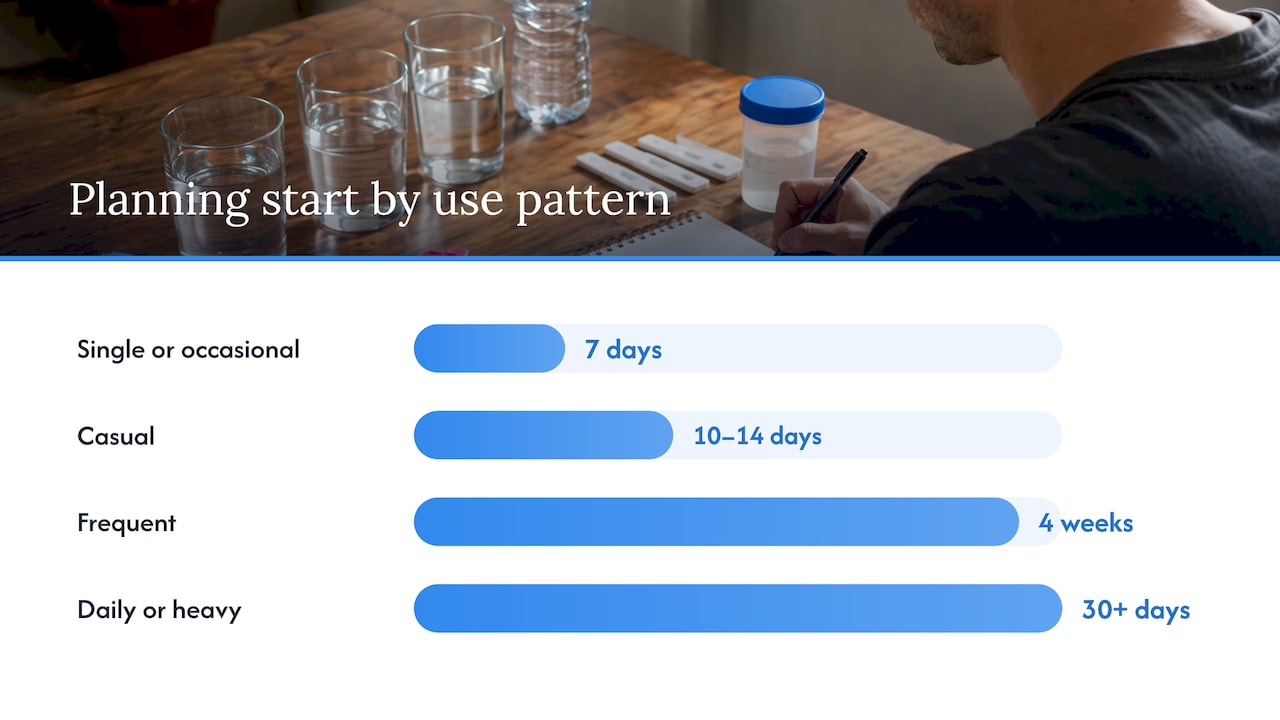
| Use pattern | Typical urine window (sourced ranges) | Suggested planning start |
|---|---|---|
| Single use or very occasional | About 3 to 7 days, depending on cutoff | At least 7 days out |
| Casual, a few times a month | Up to about 10 days on average | 10 to 14 days out |
| Frequent, several times a week | 2 to 4 weeks | 4 weeks out |
| Daily or heavy | A month or longer | 30 days or more, as early as possible |
The last column is our planning advice, not a lab figure. We suggest building in a buffer because nobody can read your exact clearance from a chart.
So, is three days enough? For a one-time or very occasional user facing a 50 ng/mL cutoff, it can be. For anyone using regularly, three days is a gamble. If you are in the second group, read the heavy-user section below.
For more on how urine screens read THC, see our guide to the urine test for THC and the federal 50/15 ng/mL cutoff levels.
Heavy user timeline: a realistic plan
The ACMT statement says chronic heavy users may remain urine-positive for a month or longer. THC-COOH, the metabolite urine tests look for, is stored and released slowly, so heavy users clear it slowly. A peer-reviewed workplace-testing review notes the target is an inactive metabolite that may persist for weeks or months in chronic users, which is why a positive does not necessarily mean recent use.
Here is the schedule we give heavy users who have a few weeks:
- Day 0, stop use. Every day you keep using resets the clock. This is the single biggest lever you control.
- Week 1 to 2: drink water normally, eat regular meals, and move your body. Avoid extreme measures such as overloading on water, which can produce a dilute sample, and a dilute sample can lead to a retest.
- Week 2 to 3: if your test is on a fixed date, order your products now so nothing arrives late. Read the instructions end to end before the day you need them.
- Final 24 to 48 hours: follow the product timing for your chosen urine-support product, such as the Macujo Premium Detox Drink or the Macujo Premium Detoxifying Tea, exactly as written.
- Test morning: follow the label timing, and bring the ID and paperwork the collection site requires.
If you want a schedule fitted to your own history, the Macujo calculator and a consultation exist for that purpose. Our policy is to keep supporting you until you pass.
Hair test timeline: where most people run out of time
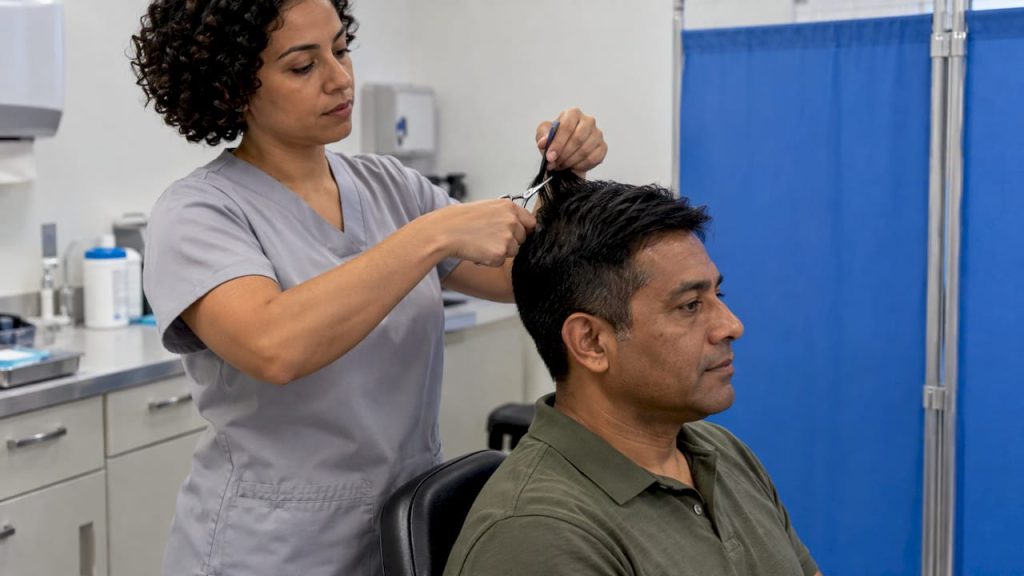
A hair test is a different problem. Labcorp describes hair testing as offering up to a 90-day window for detection of drug use, collected from about 100 milligrams of hair cut close to the scalp. Abstaining for two weeks does not empty that window, because the hair already holds the record.
That is why a hair plan is built around cleansing the hair shaft itself, and why we focus on it here. Our deeper guides cover the 90-day hair detection window and an evidence-based THC hair detox plan. If you vape, see detection times for vaping THC.
A hair prep schedule with Macujo Aloe Rid
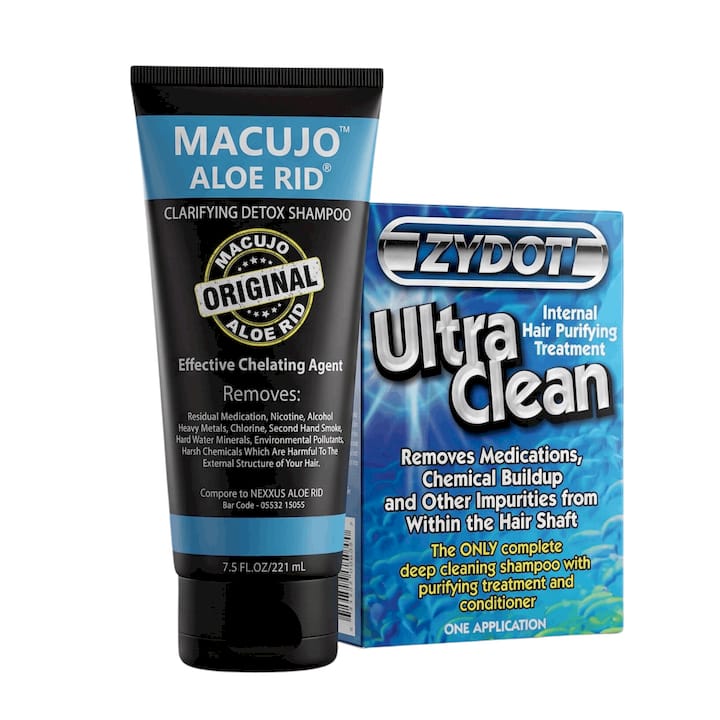
Macujo Aloe Rid Shampoo is a hair-cleansing shampoo built around the Macujo Method. It is designed to help cleanse the hair of the residues that hair testing looks for, and it works as part of a routine, not as a one-off wash. Here is how we lay out the days:
- As soon as you hear about the test: stop use, and stop adding new exposure to your hair, including secondhand smoke where you can avoid it. Order your shampoo right away.
- Days 1 to 7 before the test: start the wash routine according to the instructions and the wash calculator. Your hair length, thickness and history change the number of washes. The calculator exists so you are not guessing.
- Final days: keep to the schedule, do not skip a session, and keep the hair clean and free of new products that are not part of the plan.
- Morning of collection: follow the last step in the instructions and arrive on time.
The Macujo Aloe Rid and Zydot Ultra Clean Shampoo Detox Bundle pairs the Aloe Rid shampoo with a second cleanser for people who want the full routine in one order.
Two honest cautions belong here. First, no home routine can guarantee a lab result, because the lab, the cutoff and your hair all vary. Second, if a retest or confirmation is likely, make the plan more conservative, not less. Heavy users with long hair should talk to us before the final week, not during it.
On probation or under court-ordered testing, the stakes and the rules differ. See our page on passing probation drug tests.
Saliva and blood: short windows, short plans
Saliva tests catch recent use, so the plan is compressed. Published ranges vary. One medical review cited by a recovery provider puts saliva detection at roughly one to three days, though results shift with how often you use. If you are a daily user, give yourself a week of no use to be safe, and use a mouth-focused product timed to the test.
Blood tests are usually run after an accident or on reasonable suspicion, and they are rarely scheduled in advance, so there is no meaningful prep window.
On federal testing, SAMHSA reported that final oral-fluid guidelines were published on October 10, 2023, and final urine guidelines on October 12, 2023, with the urine provisions effective February 1, 2024. Federal programs may use urine, oral fluid or both, and the model plan for federal workplaces lists applicant, random, reasonable-suspicion, post-accident, voluntary and follow-up testing as possible circumstances. Private employers set their own policies, so ask HR which specimen they use.
How the test itself works
Knowing the process helps you plan. NIDA explains that initial urine screens generally use immunoassay, while confirmation uses more specific methods such as GC/MS or LC/MS, and notes that urine tests cannot establish time since last ingestion, duration of use or intoxication. It also notes false negatives can occur when a cutoff is too high or a specimen is adulterated, which is one reason we advise against shortcuts that tamper with the sample.
If you want to check yourself first, home kits are a reasonable step. The FDA says home-use tests list marijuana as potentially positive 1 to 3 hours after use and for 1 to 7 days, but these are only guidelines. The agency also says collection, storage, food, drink, medicines and timing can affect results, and a negative is not proof that use did not occur. Treat a home result as preliminary, and treat a presumptive positive as something a lab would confirm.
For drugs beyond THC, our drug detection times and how long drugs stay in your system pages give a fuller picture, and there is a separate page on opiates in urine.
What changes your timeline
The ACMT and Wisconsin documents agree on the main variables. Here is how to read them:
- Frequency and duration of use: the strongest factor. More use means more stored metabolite.
- Dose and route: edibles, vapes and smoking differ in exposure.
- Metabolism and body composition: THC is fat-soluble, so adiposity matters.
- Hydration, diet, exercise and age: the CDC lists these as influences on urine results. The CDC also notes 80% to 90% of a delta-9-THC dose is excreted within 5 days, mostly in feces and urine, but trace metabolites can linger beyond that.
- Cutoff level: a 20 ng/mL screen catches more than a 50 ng/mL screen.
The Wisconsin sheet stresses that a detection window is the period until the last positive sample, not until every THC molecule has left the body. That is why the day-count tables describe likelihood, and why we recommend a buffer.
Our perspective
Most people write to us with the same problem: the date is close and the plan is vague. In twenty years, the pattern we see is that the people who do best act on the first day, not the last.
We built the Macujo Method around that idea. The test type decides the tool. Hair needs a cleansing routine for the shaft, so we put Macujo Aloe Rid Shampoo at the center of our hair plans. Urine and saliva need timing, so we give you product schedules that fit your date. A calculator and step-by-step videos keep you from guessing.
What we offer beyond the products is the person on the other side. Unlimited consultations until you pass, and a plan you can follow without second-guessing every step. That is what we stand behind.
Detox Experts
Start your plan today
If you have a hair test coming, our shampoo routine is where we would begin. The Aloe Rid and Zydot shampoo bundle gives you the full set, and a private consultation with Mike Macujo will turn your test date and history into a day-by-day schedule. For urine and saliva products, browse the full range at PassUSA.

FAQ
Is three days enough to detox before a drug test?
For a single or very occasional use and a 50 ng/mL urine cutoff, detection beyond 3 to 4 days is unusual, per the Wisconsin court fact sheet. For regular users, three days is rarely enough, and a hair test is not affected by three days at all. Plan longer whenever you can.
How many days does a heavy user need?
Plan on 30 days or more for urine, since chronic heavy users may stay positive for a month or longer. For hair, the lookback is about 90 days, so start the cleansing routine the moment you know the test is coming. A consultation can map this to your own date.
When should I start preparing for a hair follicle test?
Start immediately and stop use the same day. Hair holds a roughly 90-day record, so the routine is about cleansing the hair shaft in the days before collection. Use the wash calculator to set the number of washes for your hair length and history.
Does a negative home test mean I will pass the lab test?
No. The FDA says a negative home result is not proof that use did not occur, and that collection, food, medicines and timing can affect results. Home kits are a useful preliminary check, but the lab test uses more sensitive confirmation methods.
Sources
- ACMT Position Statement: Interpretation of Urine for Cannabis
- CDC: Urine Testing for Detection of Marijuana, An Advisory
- Wisconsin Courts: The marijuana detection window fact sheet
- Northwestern Medicine: Cannabinoid Screen and Confirmation (Urine)
- Interpretation of Workplace Tests for Cannabinoids
- NIDA: Drug Testing
- FDA: Drugs of Abuse Home Use Test
- Labcorp: Hair Follicle Drug Testing
- SAMHSA: DTAB Open Session Meeting Transcript, December 5, 2023
- SAMHSA: Model Plan for a Comprehensive Federal Drug-Free Workplace Program