


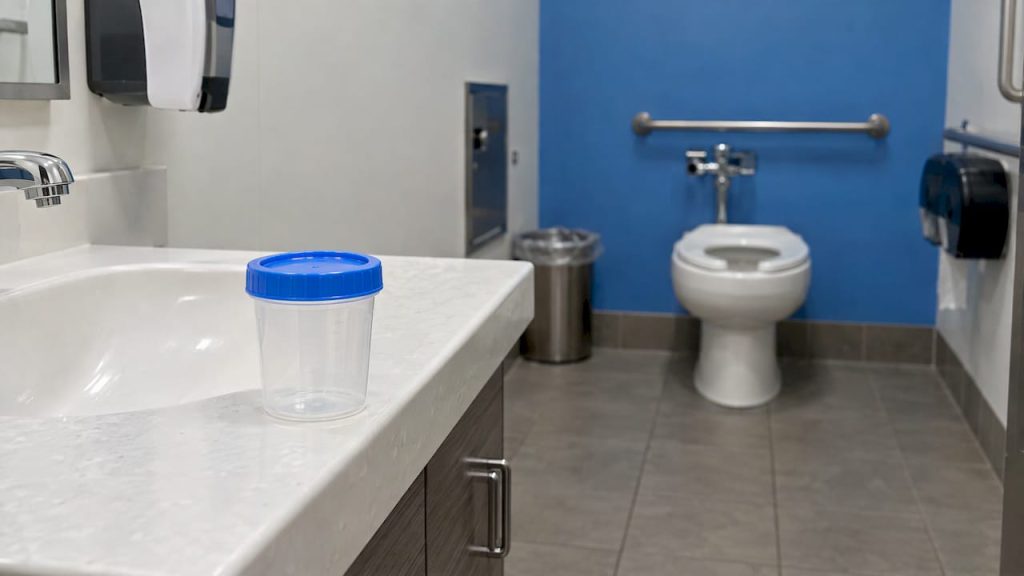
A midstream urine drug test is a standard urine screen where you start urinating into the toilet, catch the middle part of the stream in a collection cup, and finish in the toilet. The method keeps the sample clean. What the lab does with it afterward, and how you prepare, matters far more than the collection itself. Below you will find how the collection works, what gets checked, how long substances can show up, and how to prepare for urine, saliva and hair screens.
TL;DR
- “Midstream” describes how the sample is caught: the first part of the stream goes in the toilet, the middle goes in the cup, and the end goes back in the toilet.
- Labs check the sample itself, including temperature, creatinine and pH, before they look for drugs. A normal, properly collected sample avoids avoidable problems.
- A first screen is presumptive. A positive is confirmed by a second, more specific lab method, and in workplace programs a physician reviews it.
- Hair follicle tests work differently from urine tests, so hair needs its own preparation. Our Macujo Aloe Rid Shampoo is designed for that job.
- We offer products for each test type and unlimited consultations until you pass.
Table of Contents
- What a midstream urine sample actually is
- How to give a midstream sample step by step
- What happens to the sample after you hand it over
- How long substances can show up in urine
- Preparing for a urine test
- Why hair tests need a different plan
- Saliva tests in brief
- Which test, which tool
- Our perspective
- Get your plan in place
- FAQ
- Sources
What a midstream urine sample actually is
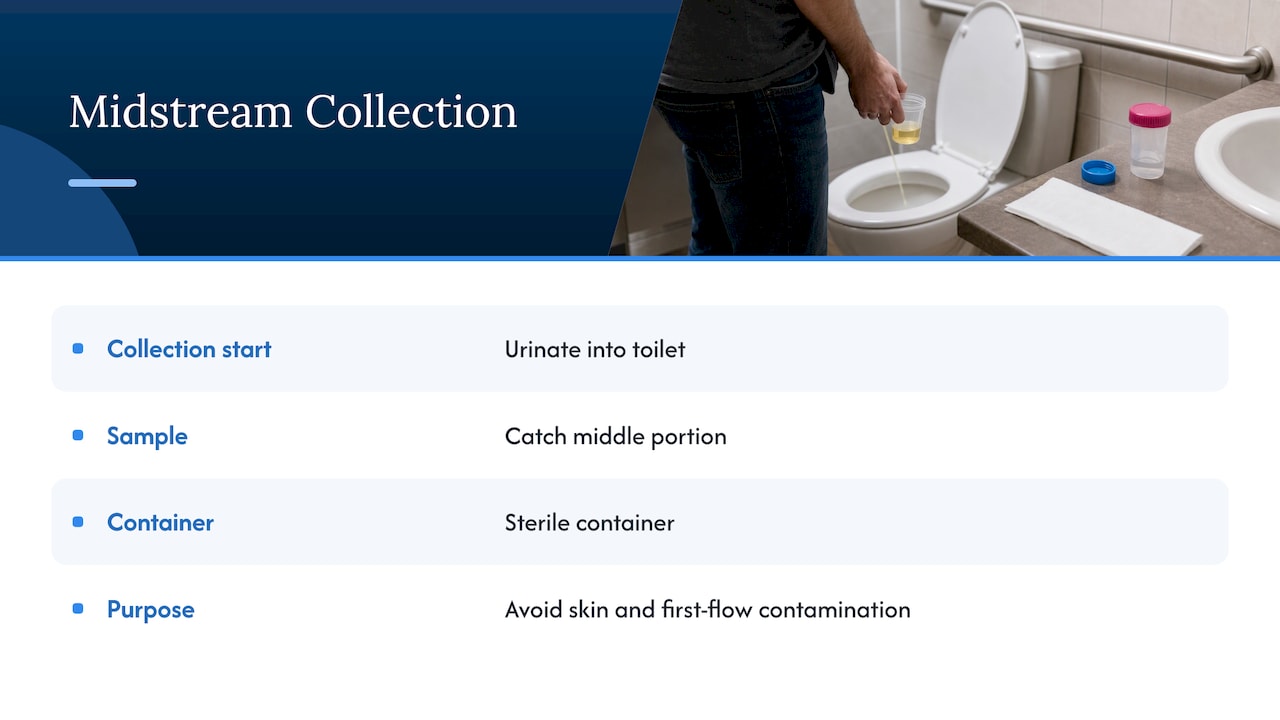
MedlinePlus describes a midstream, or “clean-catch,” sample as one collected by starting to urinate into the toilet to clear the urethra of contaminants, then catching the middle portion in a sterile container. The same page covers the urine drug screen itself.
So the term has nothing to do with which drugs are tested. It is a collection technique. The same cup can go to a clinic, an employer’s collection site or a lab. If your paperwork says “midstream,” it means the collector wants a sample without contamination from the skin or the first flow.
How to give a midstream sample step by step
Follow the instructions the collector gives you. They override anything general. In broad terms, MedlinePlus lays out the process like this:
- Wash your hands.
- Clean the genital area as directed.
- Begin urinating into the toilet.
- Move the container into the stream and catch about 1 to 2 ounces.
- Remove the container, finish urinating in the toilet, and hand over the sample as instructed.
The MedlinePlus urine drug screen page gives the amounts and wording. Do not stop and restart more than you need to, and do not overfill the cup. Collectors need a specific volume, and a rushed or messy collection can slow everything down.
Volume in workplace testing
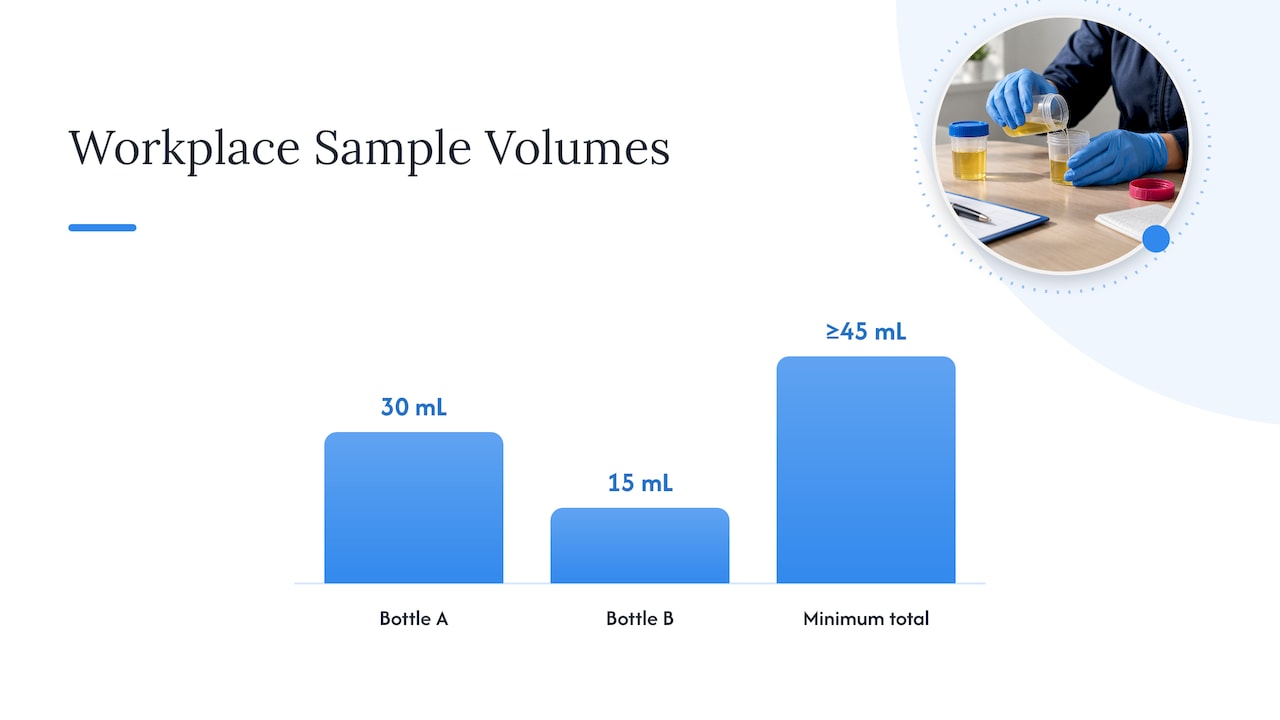
In Department of Transportation testing, collectors split one void into two bottles: 30 mL for Bottle A and 15 mL for Bottle B. The SAMHSA guidance for federal programs lists the same minimums. If you are called for a DOT or federal test, plan to be able to provide at least 45 mL. Drink normal amounts of fluid beforehand rather than going in dehydrated, and read our page on drug screening procedures to see what a typical collection visit looks like.
What happens to the sample after you hand it over
The cup does not go straight to a drug result. Several things happen first.
Validity checks come first
For federal workplace programs, SAMHSA guidance sets out what a valid specimen looks like:
- Temperature between 90° and 100°F (32° to 38°C), measured within 4 minutes of voiding.
- Creatinine and pH testing on every specimen.
- Specific gravity testing if creatinine is below 20.0 mg/dL.
- Testing for oxidizing adulterants.
These checks exist to tell whether a sample is a real, normal human urine specimen. We explain them in more depth in how labs judge urine test validity, in our guide to SAMHSA creatinine rules, and in our piece on urine pH in drug tests. A high or low pH, or a very dilute sample, is not a diagnosis of anything. It is a flag that triggers a closer look.
The first screen is presumptive
The usual first step is an immunoassay, which uses antibodies to detect drug classes such as cannabis, cocaine, amphetamines, opiates and benzodiazepines. According to SAMHSA’s guidance for Medical Review Officers, this method is fast and sensitive but can be nonspecific, so positive results need confirmation.
Confirmation uses mass spectrometry
MedlinePlus notes that foods, prescription medicines and other drugs can cause false-positive screens, and that a positive may be confirmed with gas chromatography mass spectrometry (GC-MS). In federally regulated programs, the SAMHSA manual says confirmation must combine chromatographic separation with mass spectrometric identification. Our walkthrough of the GC-MS drug test covers the lab steps.
Medical review
In federal programs, a Medical Review Officer, a licensed physician, reviews the paperwork and interviews you to find out whether there is a legitimate medical explanation. If you take a prescription medication, tell the collector and the MRO. Bring the prescription details with you to the MRO interview, since that is the step where they matter.
How long substances can show up in urine
There is no single number. Detection depends on the substance, how often and how much you used, your metabolism and your hydration. A study of cannabis metabolite elimination found that the initial creatinine-normalized concentration of THCCOOH drove how long samples stayed positive, with some positive specimens up to 30 days. Creatinine normalization adjusts for how dilute the urine is, which is why labs pay attention to creatinine at all.
In practice, this means a casual user and a daily user can have very different timelines. For details, see how long drugs stay in your system and THC urine detection time.
Preparing for a urine test
Urine is the most common workplace format, so most people who search this are preparing for one. Preparation works best when it starts well before the day of the test. If you have a screening coming up, here is how we suggest approaching it.
- Find out the test type. A pre-employment screen, a random test and a DOT test can differ in panel and in how collection is supervised. Ask the employer or read the notice.
- Know your timeline. The days between your last use and the test shape your plan. Our guides on passing urinalysis tests and the urine test for THC lay out what to consider.
- Check where you stand. An at-home screen like our 13-panel urine drug test dip card lets you see a result privately before the official test, so you are not guessing.
- Choose a plan that fits your window. Cannabis users can start with our page on how to pass a weed urine drug test.
- Arrive normally hydrated and on time. Showing up flustered does not help. Bring photo ID, and follow the collector’s directions exactly.
If you want a person to walk through your specific timeline, our private consultation with Mike Macujo is built for that.
Why hair tests need a different plan
Most readers searching for a midstream urine test are headed to a urine screen. But many employers, especially for pre-employment or safety-sensitive roles, use hair follicle tests instead or in addition. Urine reflects what your body is excreting. A hair test looks at substances carried into the hair itself, so a plan that only addresses urine leaves the hair side open.
That is why we built a large part of our work around hair. The Macujo Method pairs specific products with a step-by-step routine for your test type, and for hair the foundation is cleansing the hair shaft before the sample is cut. Our Macujo Aloe Rid Shampoo is designed to be used as part of that routine, to help cleanse toxins from your hair before a follicle test. Our own page on hair prep for lab testing also explains why the lab method matters for hair samples.
A few practical points we give customers:
- Start early. Hair prep is a routine, not a one-night fix. The more days you can run it before collection, the better.
- Follow the instructions in order. The Method is a sequence. Step-by-step videos and the Macujo wash calculator help you plan how many washes fit your timeline.
- Tell us your situation. Hair length, color treatments and the lab’s panel all change the plan. This is what the consultation is for.
Saliva tests in brief
Saliva, or oral fluid, screens are quick, observed collections, and they come up in random and post-incident testing. There is no stream to catch, so the preparation is different: it focuses on the mouth and the recent window. We carry detox mouthwash for this purpose, and our 12-panel oral fluid saliva test lets you check yourself first. A consultation can match the plan to how little time you have.
Which test, which tool
| Test type | How it is collected | What we offer |
|---|---|---|
| Urine | Midstream sample in a collection cup | Urine detox products, at-home 13-panel dip card, personalized consultation |
| Hair | A hair sample is cut near the scalp | Macujo Aloe Rid Shampoo, wash calculator, step-by-step videos |
| Saliva | Oral fluid swab | Detox mouthwash, 12-panel saliva test |
Our perspective
After more than 20 years helping people through drug screenings, we see the same pattern. People worry about the cup, but the people who do best are the ones who understood their whole situation first: which test, how many days, and which products fit that window.
That is why we built the Macujo Method around the specific test type, with a calculator and step-by-step video instructions rather than a one-size-fits-all bottle. Hair, urine and saliva each need their own approach, and a plan made for one does not carry over to the next.
It is also why we offer unlimited consultations until you pass. A test is a high-stakes moment, and you should not have to figure it out alone. If you have a hair test coming, start with the Aloe Rid Shampoo routine. If it is urine or saliva, we will help you build the right plan for your timeline.
Detox Experts
Get your plan in place
Whatever format your test uses, the best time to prepare is now. We carry hair, urine and saliva products, at-home test kits to check where you stand, and personalized support from the team behind the Macujo Method. Our claim, and our promise to customers, is that we help you until you pass your test.
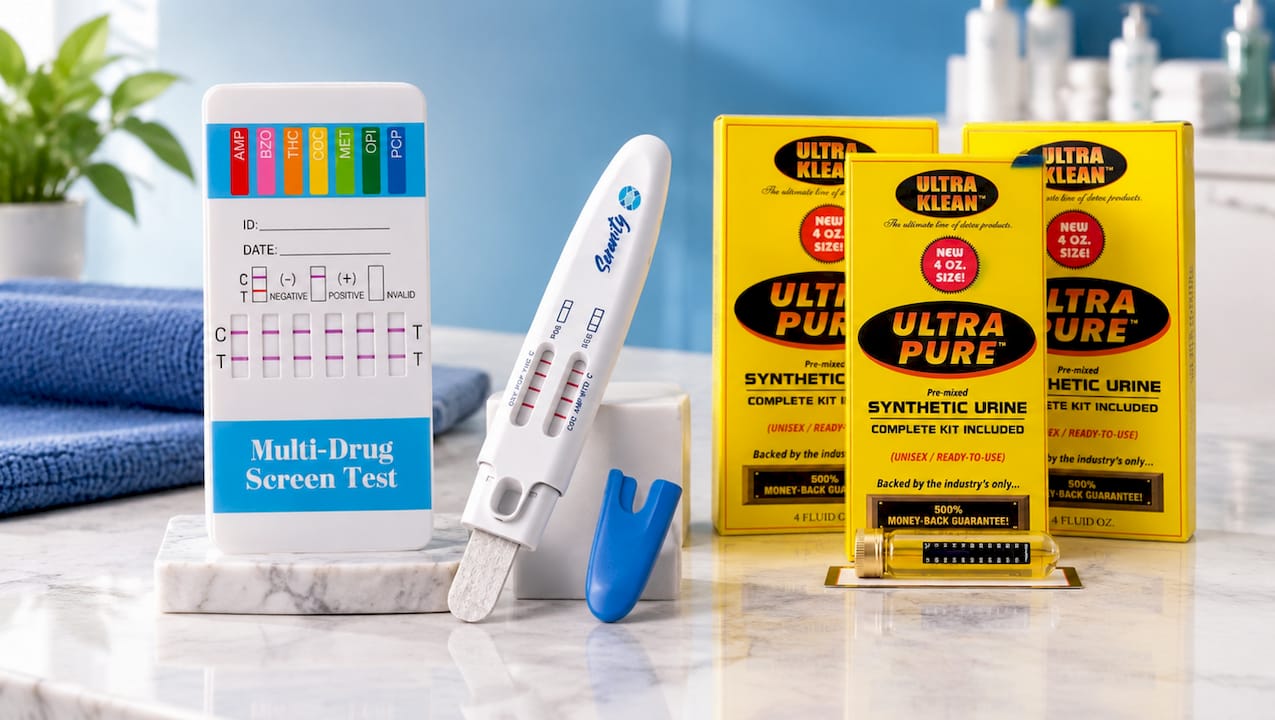
Browse the full range on our hair, urine and saliva test product pages, or book a private consultation with Mike Macujo to map out your timeline.
FAQ
What is a midstream urine sample?
It is a clean-catch sample. You urinate into the toilet first, catch the middle of the stream in the container, then finish in the toilet. According to MedlinePlus, this clears the urethra of contaminants before the sample is taken.
How much urine do I need to provide?
MedlinePlus describes catching about 1 to 2 ounces for a clean-catch sample. For DOT and federal testing, the collector splits the void into 30 mL and 15 mL bottles, so you need to be able to give at least 45 mL. Follow your collector’s directions.
Can a urine drug test give a false positive?
Yes. Foods, prescription medicines and other drugs can cause a false-positive screen, and MedlinePlus notes that positives may be confirmed with GC-MS. In workplace programs, an MRO interviews you about any medical explanation, so tell the collector about prescriptions.
Does a midstream urine test also check for hair or saliva drugs?
No. Each test looks at its own specimen, so a urine result says nothing about hair or saliva. If your employer uses hair follicle testing, prepare for that separately. Our Macujo Aloe Rid Shampoo routine is designed for hair.
How long should I prepare before a urine test?
As long as your timeline allows. Detection varies with the substance, how often you used it, metabolism and hydration. If your test is close, a private consultation can help you work out a plan.
Sources
- Urine drug screen, MedlinePlus Medical Encyclopedia
- Medical Review Officer Guidance Manual for Federal Workplace Drug Testing, SAMHSA
- Back to Basics for Urine Collectors, US Department of Transportation
- Urinary elimination of 11-nor-9-carboxy-delta-9-tetrahydrocannabinol in cannabis users