

A hair follicle cutoff level is the concentration of a drug or metabolite, measured in picograms per milligram (pg/mg) of hair, at or above which a lab reports a positive result. Below it, the result is reported negative. The numbers are tiny, they differ by drug, and they are not set by one federal rule for every employer. This guide lays out the levels a major U.S. lab publishes, explains how to read them, and shows how we help people prepare for a test.
TL;DR
- A cutoff is a lab’s pass/fail line: at or above it is positive, below it is negative.
- One large U.S. lab uses 500 pg/mg for cocaine and amphetamines, 200 pg/mg for opiates, 300 pg/mg for PCP and 1.0 pg/mg (screen) and 0.1 pg/mg (confirmation) for the marijuana metabolite.
- There is no final federal hair standard for employers, so levels can vary by lab and test panel.
- Hair reflects roughly 90 days of history, and the level cannot tell anyone how much you used.
- If you have a hair test coming, preparation starts with the right product, the right routine and the right timing. We cover all three below.
Table of Contents
- What a cutoff level actually is
- Hair follicle cutoff levels at a glance
- Are cutoffs the same everywhere?
- What a result above or below the line tells you
- How far back the test looks
- Why hair is a different kind of test
- How to prepare for a hair follicle test
- Our approach to hair preparation
- Preparing for other tests too
- Get a plan built for your test
- FAQ
- Sources
What a cutoff level actually is
The National Institute on Drug Abuse describes a cutoff as a predefined concentration at or above which a sample counts as positive. The purpose is to limit false positives, because trace amounts from incidental exposure should not be treated as use. NIDA also notes that a cutoff set too high can produce false negatives in an initial urine screen, which is why labs balance sensitivity against certainty.
Two terms matter when you read a lab report:
- Screening (initial) cutoff: the first test, usually an immunoassay. It is fast and designed to catch anything that might be positive.
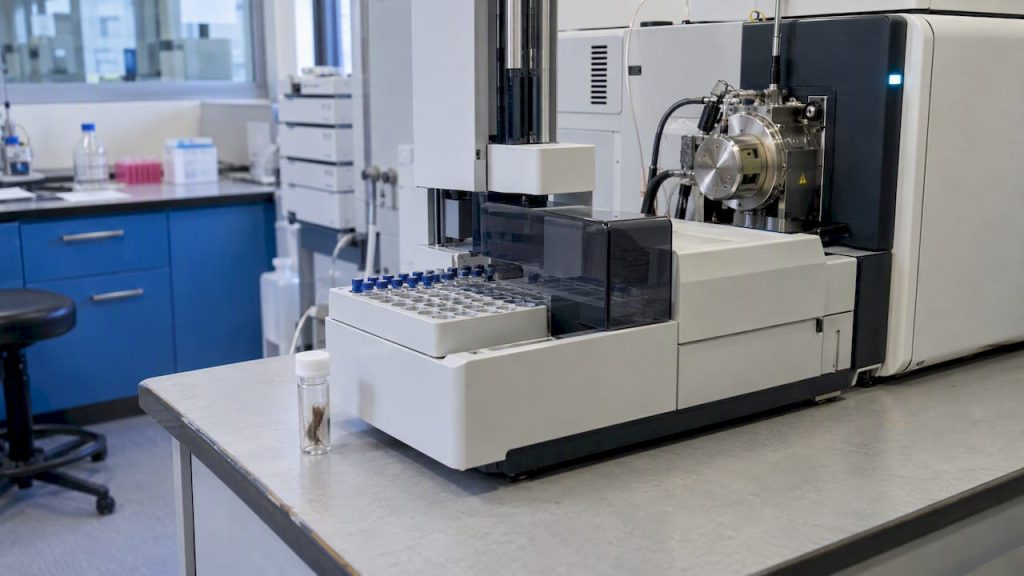
- Confirmation cutoff: a second, more specific analysis on any sample that screened positive. The Society of Hair Testing says confirmation must use chromatographic methods coupled with mass spectrometry for enough sensitivity and specificity.
A sample has to clear both steps to be reported positive. If you want a walk-through of that second step, our page on the GC/MS drug test process covers the lab stages and medical review.
Hair follicle cutoff levels at a glance
Here are the published thresholds from Quest Diagnostics, one of the largest U.S. employment testing labs. They come from the lab’s hair testing certifications and cutoff page.
| Drug class | Cutoff (pg/mg of hair) | Notes |
|---|---|---|
| Cocaine | 500 | Screening and confirmation |
| Amphetamines | 500 | Screening and confirmation |
| Opiates (morphine, codeine, 6-AM, oxycodone, oxymorphone) | 200 | Screening and confirmation |
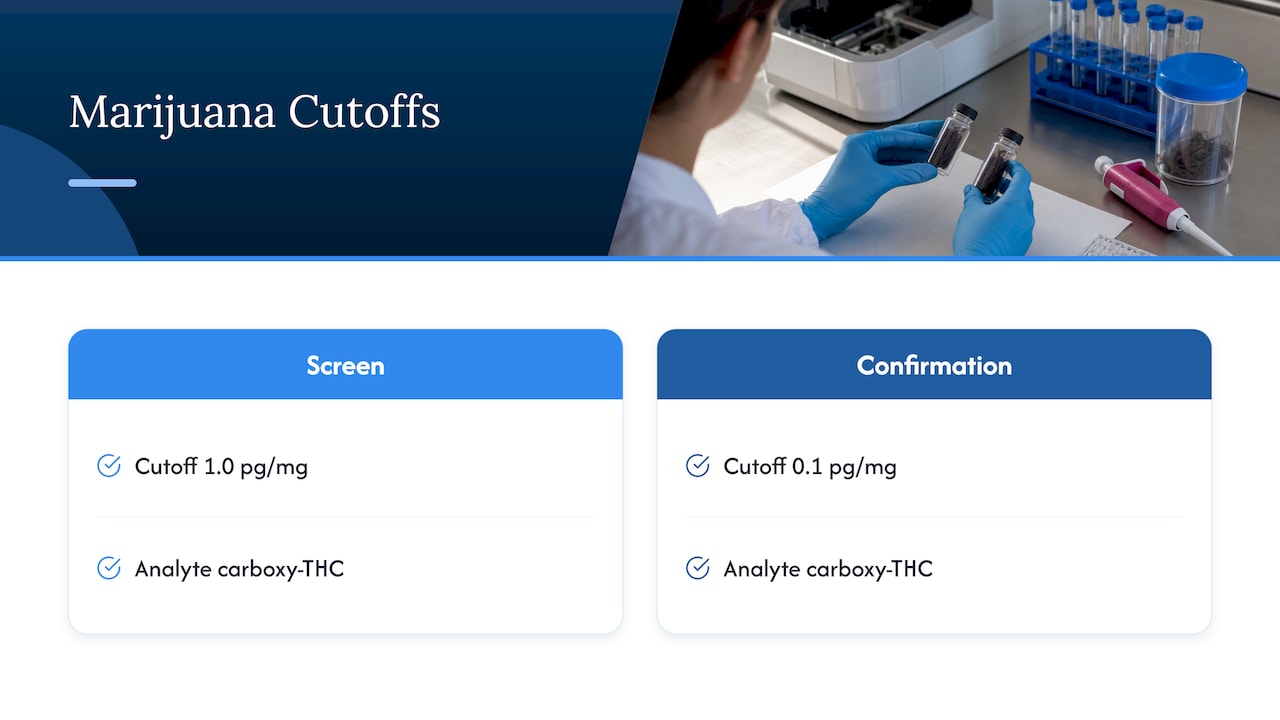
| Marijuana metabolite (THC-COOH) | 1.0 screening, 0.1 confirmation | Metabolite, not the THC itself |
| PCP | 300 | Screening and confirmation |
You may also see the same numbers written in ng/mg or ng per 10 mg. The units differ, the amounts do not: 500 pg/mg is 0.5 ng/mg. When you compare two sources, check the unit before you compare the number.
Why marijuana looks different
The marijuana line has two numbers because the screen and the confirmation target the metabolite at very different concentrations. In an FDA review of a hair test system, the screen sits at 1.0 pg/mg of carboxy-THC while confirmation runs by GC-MS/MS at 0.1 pg/mg. That is an extremely small amount, roughly a ten-thousandth of a milligram of metabolite in a gram of hair, which is why the marijuana test is the one our customers ask about most. Our page on the marijuana hair follicle test goes deeper on that panel.
Are cutoffs the same everywhere?
No. Federal agencies have not had a final hair standard. A 2023 Federal Register notice stated that no federal agencies were testing hair, and that HHS had proposed Mandatory Guidelines for hair in 2020. SAMHSA’s own 2023 meeting summary says the proposed hair guidelines were still under OMB review.
In practice this means:
- Private employers choose a lab and a panel, and the lab’s cutoffs apply.
- A 5-panel and a 10-panel hair test can screen for different drug classes.
- The Society of Hair Testing publishes its own recommended cutoffs for the profession, which labs may or may not match exactly.
If you are subject to a specific program, such as a transportation role, ask the employer or testing site which panel and lab will be used. Our guide to DOT hair marijuana testing explains how preparation changes under that rule set. For urine, the picture is more standardized: federal urine cutoffs are laid out in our SAMHSA cutoff levels guide.
What a result above or below the line tells you
A result is binary for an employer: at or above the cutoff is positive, below is negative. Behind that, the lab holds a number. People often try to read that number as a measure of how heavy their use was. The Society of Hair Testing is clear that hair concentrations cannot be used to determine the exact quantity of a drug consumed. Segmental analysis, where hair is cut into sections, can show patterns over time, and results should be interpreted with all case factors in mind.
Two hair samples can also differ for reasons unrelated to use. The 2020 Federal Register proposal notes that environmental contamination, natural hair color and cosmetic treatments can all affect results and how they are interpreted. If you believe a result is wrong, start with our guide to false positive hair tests, which covers causes, confirmation and next steps.
How far back the test looks
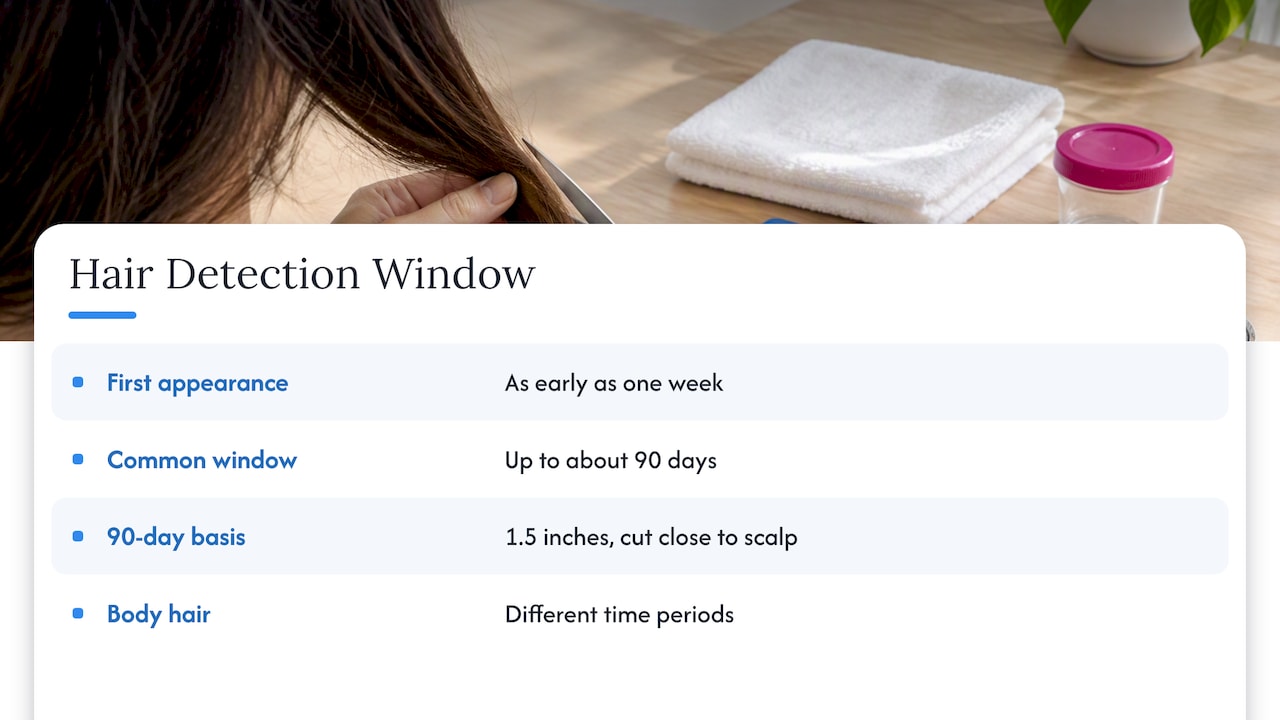
The common description is 90 days. SAMHSA’s advisory board minutes say hair testing can show use patterns for up to about 90 days, and that metabolites can appear in hair as early as one week after use. That delay is why a hair test is not a good tool for catching something that happened last night, and why it is so different from urine.
The 90-day figure assumes about 1.5 inches of head hair cut close to the scalp. Longer samples can reach further back, which is one reason the number can mislead. We explain this in why 90 days can mislead. If a collector cannot get enough head hair, body hair may be used instead, and it works on a different timeline. The Society of Hair Testing advises that hair from different body sites represents different time periods and should be interpreted with caution. Our body hair drug test guide covers site choice and the longer window.
Why hair is a different kind of test
Hair is a solid, so labs have to break down the keratin to release the drug before analysis, according to the Forensic Technology Center of Excellence. Collection is also observed. SAMHSA officials have pointed out that directly observed hair collection helps prevent the subversion and adulteration common with urine. That is why synthetic urine and similar quick fixes do nothing for a hair test, and why preparation has to happen at the hair itself, well before the collection day.
How to prepare for a hair follicle test
The cutoff is fixed by the lab. What you can control is your timeline and your routine. Here is how we suggest people work through it.
- Find out the panel and the date. Ask which drugs the test covers and when collection is scheduled. Marijuana, cocaine, opiates and amphetamines are treated differently.
- Count your runway. The more time before collection, the more washes you can complete. Short notice means a tighter, more disciplined routine.
- Build the routine around a hair-specific product. Our Macujo Aloe Rid Shampoo is designed to be used as part of a structured hair cleansing routine in the days before a test. It is used with our step-by-step instructions rather than as a one-off wash.
- Follow the schedule exactly. The Macujo Method relies on a specific combination and order of products, and on repeating it as directed. Skipping steps is the most common reason people feel unsure at the end.
- Avoid new exposure. Any new use during the preparation period works against you, since new metabolites take about a week to show up in hair and then stay in the growing strand.
- Talk to someone who has done it. If your timeline, hair type or panel is unusual, a personal consultation takes the guesswork out.
For cocaine panels, see our guide on how to prepare for a cocaine hair test. For THC, our THC hair detox plan lays out a schedule built for the 90-day window.
We are honest about one thing: no product can promise a result, because every head of hair and every exposure history is different. What we can do is give you a clear method, support through the process, and a plan matched to your test.
Our approach to hair preparation
We have helped people prepare for drug tests for more than 20 years, and hair tests are where careful planning matters most. The cutoff is a number in the lab, but your preparation is a routine at home: the right shampoo, the right order, the right timing.
That is why we built the Macujo Method around clear steps rather than a single miracle product. Macujo Aloe Rid Shampoo is designed to cleanse the hair as part of that routine, and our video instructions and wash calculator help you match it to your own test date.
Our approach is personal. With unlimited consultations until you pass your test, you are never guessing alone at three in the morning before collection day.
Detox Experts
Preparing for other tests too
Hair is where most of our readers start, but the same planning logic applies elsewhere.
- Urine: the window is much shorter and the cutoffs are standardized at the federal level. Preparation centers on drinks, timing and, for some situations, a urine test product matched to your schedule.
- Saliva: saliva tests look back only a short time, so detox mouthwash and timing are the main tools.
- At-home testing: before an official hair test, some people check where they stand with an at-home kit, so they know whether to adjust their routine.
Get a plan built for your test
If you have a hair follicle test coming, we can match a routine to your timeline. Start with our Macujo Aloe Rid Shampoo and the rest of our hair range on the Passusa hair test products page, or check your starting point with the at-home hair follicle test kit. For a plan built around your own dates, hair length and panel, book a private consultation with Mike Macujo.
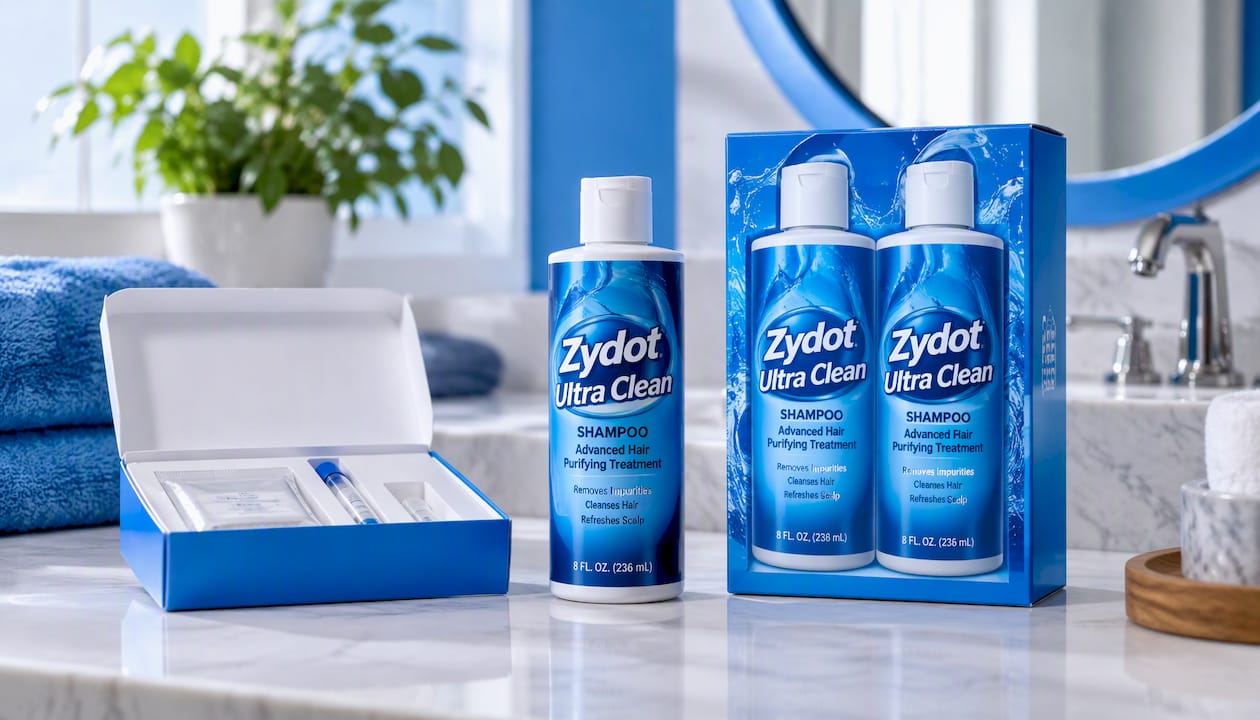
If you want to see how others approached it, our page on what success stories prove and don’t is a realistic place to start.
FAQ
What does a cutoff level mean on a hair drug test?
It is the lab’s threshold concentration for a positive result. A sample at or above it is reported positive, and a sample below it is reported negative. Cutoffs exist to limit false positives from trace exposure, according to NIDA.
Does hair length affect a hair follicle drug test?
Yes. The standard 90-day window assumes about 1.5 inches of hair near the scalp, and a longer sample reaches further back. When head hair is not available, body hair represents a different time period and is interpreted with caution, per the Society of Hair Testing.
Can a hair test show how much I used?
No. Drug concentrations in hair cannot be used to work out the exact amount consumed. Labs report whether a result is above or below the cutoff, and any pattern information comes from segmental analysis read alongside other case facts.
Are hair cutoff levels the same at every lab?
Not necessarily. There is no final federal hair standard for employers, so the lab and panel your employer picks decide the thresholds. Ask the testing site which lab and drug panel will be used before you plan.
Sources
- Drug Testing, National Institute on Drug Abuse
- 2021 SoHT Consensus on Drugs of Abuse Testing in Hair
- Hair Testing Certifications and Cutoff Levels, Quest Diagnostics
- FDA review K040257, hair THC-COOH test system
- Federal Register, Mandatory Guidelines for Federal Workplace Drug Testing Programs (2023)
- Federal Register, Mandatory Guidelines for Federal Workplace Drug Testing Programs (2020)
- SAMHSA DTAB open meeting summary, June 2023
- SAMHSA DTAB Minutes, June 11-12, 2019
- Drug Testing in Urine, Oral Fluid, and Hair, Forensic Technology Center of Excellence