


Standard 5-panel, 10-panel, and 12-panel workplace drug tests generally do not screen for kratom. Detecting mitragynine, the plant’s main active alkaloid, requires a specialized test panel and, for anything legally defensible, confirmation by mass spectrometry. At-home dip cards exist for a quick presumptive check, but they’re a screening tool, not a verdict. If a test result actually matters to your job, your legal case, or your peace of mind, the difference between a screen and a lab confirmation is the entire story.
TL;DR:
- Kratom detection requires specialized mass spectrometry tests, as standard drug panels do not screen for its main alkaloid mitragynine.
- Confirmatory testing with LC-MS/MS or LC-HRMS is necessary for legally defensible results, especially when initial screens yield positive findings.
- Urine detection windows vary from a few days for occasional use to over a week for regular users, influenced by dose, metabolism, and sample dilution methods.
- At-home dip tests for kratom are less sensitive and cannot identify specific alkaloids, making them useful as preliminary checks but not definitive proof.
- Cross-reactivity can cause false positives for methadone or other drugs, so positive immunoassays should always be confirmed with lab-based mass spectrometry.
Table of Contents
- Does Kratom Show Up on a Drug Test?
- How Long Does Kratom Stay in Your System?
- Can At-Home Kratom Urine Tests Catch a Positive Before a Real Test?
- Why Would Kratom Cause a False Positive for a Different Drug?
- What Should You Do Before and After a Kratom Drug Test?
- How Hair Testing Changes the Equation for Kratom
- Our Take on Kratom Testing Advice Online
- Get Ready for Your Next Test the Right Way
- Sources
- FAQ
Does Kratom Show Up on a Drug Test?
The honest answer is: not unless someone specifically orders it. Kratom isn’t part of the standard SAMHSA five-panel test, and it’s not on most 10-panel or 12-panel workplace kits either. Those panels are built around opioids, amphetamines, THC metabolites, PCP, and cocaine, not the alkaloids found in kratom leaf. An employer or clinic has to request an expanded, kratom-specific panel by name, and major labs like LabCorp require a distinct test code to run it.
That’s a fact worth sitting with if you’ve been told “kratom doesn’t show up on drug tests” as if it were a blanket rule. It’s more accurate to say kratom doesn’t show up on the drug tests almost everyone is thinking of. Specialized panels absolutely can catch it.
What labs actually target
Kratom detection hinges on a small family of alkaloids and their metabolites:
- Mitragynine — the primary active compound and the usual target analyte.
- 7-hydroxymitragynine — a potent metabolite formed as the body processes mitragynine.
- Speciociliatine and speciogynine — diastereomers (molecules with the same atoms, different 3D arrangement) that share mitragynine’s exact mass and can be mistaken for it without proper separation.
Routine immunoassay screens, the cheap antibody-based strips used in most workplace and clinical testing, simply aren’t built to recognize these molecules. That’s why confirmation requires liquid chromatography tandem mass spectrometry (LC-MS/MS) or liquid chromatography high-resolution mass spectrometry (LC-HRMS), techniques that physically separate compounds by weight and charge before identifying them.
Statistic callout: Validated LC-MS/MS assays have measured mitragynine in urine with a lower limit of quantification (LLOQ) around 1.00 ng/mL, and forensic sample sets have shown positive results ranging from roughly 1.2 ng/mL up into the tens of thousands. That’s an enormous range, and it’s part of why a single cutoff number rarely tells the whole story.
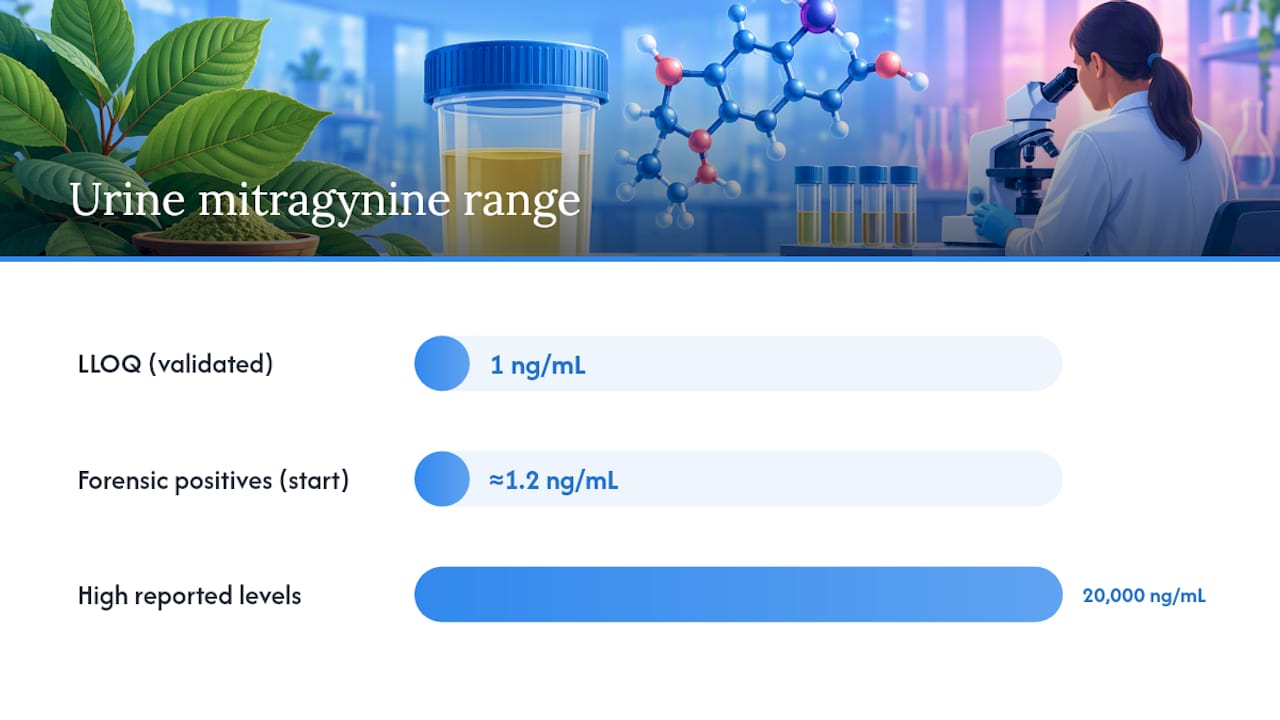
One technical wrinkle matters more than most people realize: mitragynine, speciociliatine, and speciogynine can co-elute (show up at the same time) on less sophisticated LC-HRMS runs because they share identical exact masses and similar fragmentation patterns. Without proper chromatographic separation, a lab might misidentify which diastereomer it’s actually looking at. Improved separation methods have pushed quantification limits down to around 1 microgram per liter, but not every lab uses those methods, which is exactly why kratom reporting varies so much from one testing facility to the next.
How Long Does Kratom Stay in Your System?
There’s no single number here, and anyone who gives you one without caveats is oversimplifying. Detection windows in urine depend heavily on dose, frequency, hydration, metabolism, and which analyte the lab is actually measuring.
Occasional or single-use kratom tends to clear from urine within a few days for most people. Regular, heavier use extends that window, sometimes into the range of a week or slightly longer, because alkaloids accumulate in fat tissue and release back into circulation gradually. This mirrors what’s seen with other lipophilic (fat-soluble) compounds, and it’s consistent with kratom’s mixed pharmacology: stimulant-like at low doses, more opioid-like at higher ones, a profile NIDA’s kratom research summary covers in more depth.
Statistic callout: Forensic urine testing has identified mitragynine concentrations spanning from about 1.2 ng/mL to over 50,000 ng/mL in confirmed positive samples. That’s not a typo. It reflects how wildly dose, product potency, and time-since-use can swing a result.
A few practical factors change what shows up on paper, even when the underlying kratom use hasn’t changed:
- Creatinine correction — labs normalize results against creatinine levels to catch diluted samples, so a heavily hydrated specimen won’t artificially read “clean.”
- Enzymatic hydrolysis choices — some lab prep methods break down conjugated metabolites before testing, which can raise measured concentrations for certain compounds compared to methods that skip this step.
- Diastereomer ratios — speciociliatine and speciogynine sometimes appear in urine at higher concentrations than mitragynine itself, making them useful backup biomarkers when the primary alkaloid has already dropped below a lab’s cutoff.
- Product variability — kratom sold under different names or sourced differently can carry different alkaloid ratios, which shifts what a test actually finds.
None of this is data you can control after the fact. It’s data that should shape how far in advance you plan, especially if you’re using a urine screening product to check yourself before a real test.
Can At-Home Kratom Urine Tests Catch a Positive Before a Real Test?
Yes, with real limits. At-home dip cards and strips use the same basic immunoassay chemistry as clinical rapid screens: antibodies bind to a target compound and trigger a color change. Some kratom-specific strips advertise cutoffs around 300 ng/mL, which is far less sensitive than the roughly 1 ng/mL LLOQ a confirmatory lab assay can hit.
That gap matters. A dip card can miss a low-level positive that a full lab panel would catch, and it can’t distinguish mitragynine from its diastereomers the way LC-MS/MS can.
Pros of at-home screening:
- Fast results, usually within minutes.
- Private, no appointment or lab visit required.
- Useful as an early warning several days before a scheduled test.
Cons worth taking seriously:
- Lower sensitivity means borderline concentrations can read falsely negative.
- No ability to confirm identity of the specific alkaloid detected.
- Not accepted as legal or employment documentation, screening only.
Here’s a step-by-step approach that actually works if you’re using an at-home kratom screen to plan ahead:
- Test several days before your actual deadline, not the morning of, so a borderline result still gives you time to act.
- Follow the collection instructions exactly — first-morning urine is typically more concentrated and gives a more reliable read than a diluted midday sample.
- Treat a negative as reassuring, not guaranteed — low-level presence can still fall under the strip’s cutoff.
- Repeat 24 to 48 hours later if your result is close to the line, since concentration can shift day to day.
Pro Tip: Don’t chug water right before an at-home test hoping to “clean” the sample. Overdilution often triggers a low-creatinine flag on lab tests, which can draw more scrutiny than a straightforward result would have.
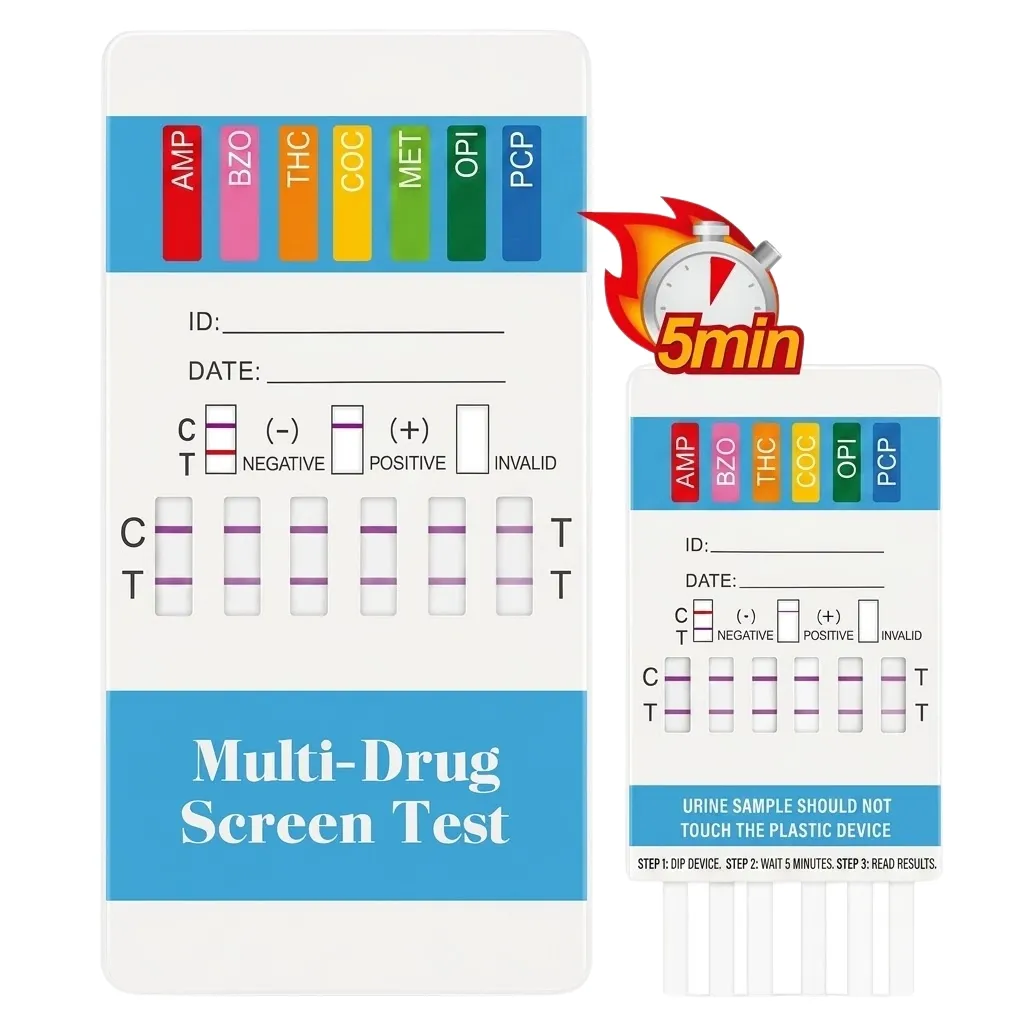
Passusa’s 13-Panel Urine Drug Test Dip Card is one option built for exactly this kind of pre-check, giving you a clinical-grade read at home before anything official is on the line.
Why Would Kratom Cause a False Positive for a Different Drug?
This is the part almost nobody warns people about: kratom use has been documented to trigger false-positive immunoassay results for methadone metabolite screens, specifically the EDDP target. A case series found urine specimens that screened positive for EDDP on immunoassay but came back negative for methadone or EDDP under mass spectrometry, with mitragynine or 7-hydroxymitragynine confirmed as the actual compound present instead, according to findings published through AJCP.
That’s a real problem for someone who’s never touched methadone and suddenly has to explain an unexpected result.
| Step | What happens | Why it matters |
|---|---|---|
| Presumptive screen | Immunoassay flags a possible positive | Fast but prone to cross-reactivity |
| Reflex confirmation | Lab runs LC-MS/MS on the same sample | Identifies the actual compound present |
| Final report | Confirmed result issued with specific analyte named | This is the number that holds up |
The standard lab workflow already builds in a fix: a presumptive positive should automatically trigger reflex confirmation by mass spectrometry before anyone treats the result as final. If that didn’t happen, or if you’re not sure it did, you have grounds to push back.
- Ask explicitly whether the positive was confirmed by LC-MS/MS or only flagged by immunoassay.
- Request the specific analyte name and cutoff concentration used in the report.
- Secure chain-of-custody documentation if the result affects employment or legal standing.
Passusa’s guide on drug test false positives walks through how to contest a result you believe is wrong, and it’s worth reading before you accept any presumptive positive as the final word.
What Should You Do Before and After a Kratom Drug Test?
Panic doesn’t help here. A clear sequence does.
- Find out exactly what’s being tested. Ask the ordering organization or lab which panel and analytes were requested. Kratom-specific screening at a lab like LabCorp requires a distinct test code, not the default panel, so a “standard” test likely isn’t looking for it at all.
- Self-screen a few days ahead if you’re uncertain. An at-home dip card gives you a private read before anything official happens. Passusa also carries a 12-Panel Multi-Drug Oral Fluid Saliva Test for readers facing saliva-based screening instead of urine.
- If a positive comes back, request confirmation. Ask for LC-MS/MS confirmation and get copies of chain-of-custody paperwork. An independent lab retest is also an option if the stakes are high enough to justify it.
- Separate medical disclosure from employer disclosure. Tell your doctor about kratom use, it matters for drug interactions and safety. Whether you disclose to an employer is a different calculation, one that depends on company policy and, in some cases, is worth a conversation with an attorney before you say anything.
Testing for a job placement or random workplace screen isn’t the same situation as testing for a probation check or a clinical toxicology panel. The specific context should shape how cautious you are, and how quickly you move to line 3 on this list.
How Hair Testing Changes the Equation for Kratom
Urine testing gets most of the attention, but hair follicle testing is where the stakes actually get serious, and it’s where hair retains drug markers for months rather than days, because compounds get locked into the hair shaft as it grows, rather than passing through and clearing the way urine does. Research on kratom’s analytical detection confirms that plant alkaloids can be identified in hair, though kratom-specific hair testing remains less standardized than testing for THC or opioids.
This is where the Macujo Method comes in. It’s a hair detox process built specifically to strip surface residue and disrupted cortex buildup before a follicle test, using a defined sequence of cleansing steps rather than a single rinse. Passusa’s core lineup maps to this:
- Macujo Aloe Rid Shampoo — the centerpiece product for preparing hair before a follicle test, formulated to work through the multi-step Macujo process.
- Hair Test Products on the broader Passusa product catalog, for readers who need the full prep kit rather than a single item.
- Urine and saliva detox options, for readers juggling more than one type of upcoming screening.
If a urine screen showed a presumptive positive and you’re now also facing a hair test, the two situations call for different tools, and treating them as one problem usually backfires. Pro Tip: Start hair prep well before your test date. The Macujo process works through multiple wash cycles, not a single application, so last-minute timing works against you.
Confirmatory lab testing still matters here too. Consultations and products are positioned as preparation support, not a guaranteed pass, and independent lab confirmation is recommended whenever accuracy has real consequences.
Our Take on Kratom Testing Advice Online
Most of what circulates about kratom and drug testing is either too confident or not confident enough. Some sources insist kratom “never” shows up on tests, which is false the moment someone orders a specialized panel. Others treat every online kratom detox claim as gospel, ignoring that mass spectrometry confirmation is what actually decides outcomes, not a home remedy or a single water flush.
The advice that holds up is boring by comparison: know which panel is actually being run, use an at-home screen as an early warning rather than a guarantee, and treat any unexpected positive as a request for confirmation, not a verdict. For hair testing specifically, the timeline matters more than any single product claim, prep work needs days, not hours, and the Macujo Method’s structured wash sequence exists precisely because rushed, one-off attempts tend to underperform against a careful, repeated process.
If you take one thing from this, take this: cutoffs and lab methods vary enough that certainty should come from confirmation testing, not from a forum post.
— Detox Experts
Get Ready for Your Next Test the Right Way
The company has experience with hair testing prep, specifically the Macujo Method and the Aloe Rid Shampoo that anchors it, and applies similar principles across urine and saliva screening as well. Rather than guessing whether kratom will show up, use the right screening tool for your situation and know exactly what a positive or negative result actually means before it counts.
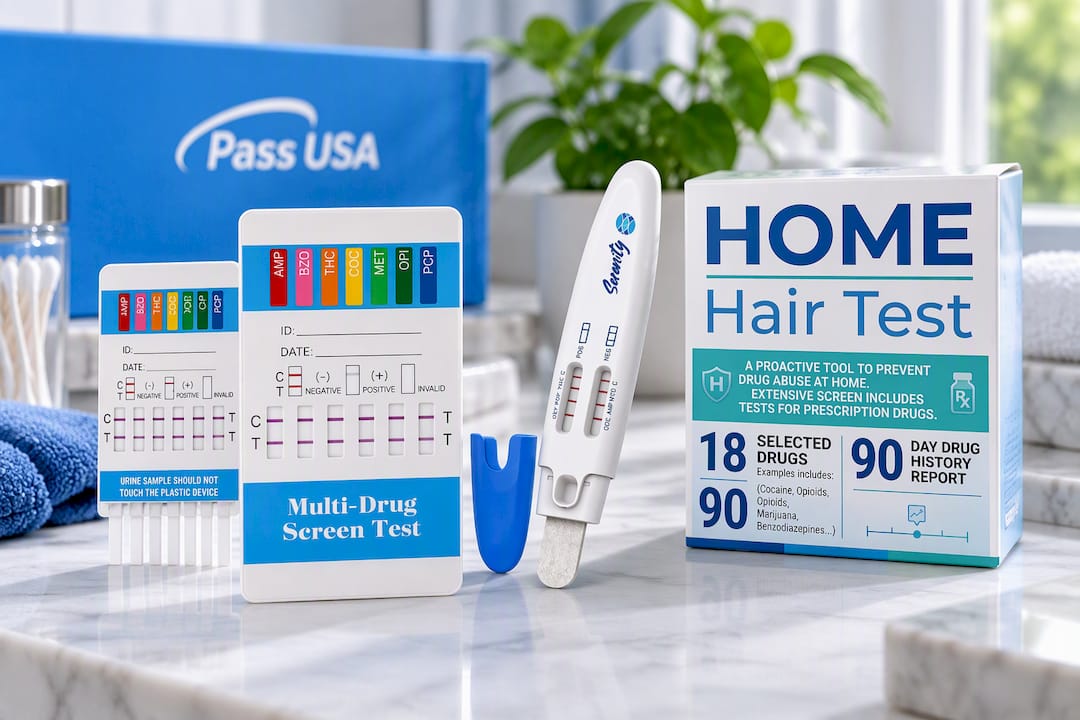
For urine screening, the 13-Panel Urine Drug Test Dip Card gives you clinical-grade results at home, useful days before a workplace or clinical test. If you’re facing a saliva-based screen instead, the 12-Panel Multi-Drug Oral Fluid Saliva Test offers the same rapid, pen-style read. And if a follicle test is on the calendar, the At-Home Hair Follicle Drug Test Kit lets you check your prep work before the real thing.
If you’d rather not guess at timing, product choice, or wash sequence on your own, a private consultation with Mike Macujo walks through your specific situation and builds a plan around your test date. Browse the full hair, urine, and saliva product lineup and pick the option that matches what you’re actually facing next.
Sources
The claims in this article draw from peer-reviewed toxicology research and laboratory-industry guidance, not forum consensus:
- Drug testing for mitragynine and kratom: Analytical challenges and medico‐legal considerations — PMC
- Validated LC-MS methods for mitragynine detection (Journal of Analytical Toxicology DOI)
- Does Kratom Show Up on a Drug Test? — ACS Laboratory
This article is general information, not a substitute for advice from a qualified doctor. Consult a qualified healthcare professional about your own circumstances before acting on anything here.
FAQ
What Class of Drug Is Kratom?
Kratom is a plant-derived substance with mixed pharmacology, acting like a mild stimulant at low doses and more like an opioid at higher doses. It’s not classified as a controlled substance federally in the United States, though its legal status varies by state and locality.
Is Kratom an Opioid, Yes or No?
Not botanically, but functionally, yes at higher doses. Its key metabolite, 7-hydroxymitragynine, binds opioid receptors similarly to traditional opioids, which is part of why some specialized drug panels test for it alongside standard opioid analytes.
What Is Kratom Called on the Street?
Common street and product names include “biak,” “ketum,” “kratom,” and various strain names tied to leaf color, such as “red vein” or “green vein” varieties. These naming differences don’t change what a lab test targets, since panels look for the mitragynine molecule itself regardless of the product name on the package.
Does Kratom Show Up on Standard Drug Tests?
Generally, no. Standard 5-panel, 10-panel, and 12-panel workplace tests don’t include kratom analytes, and detecting it requires an expanded, kratom-specific panel ordered separately by the testing organization.
How Long Does Kratom Stay in Urine?
Occasional use typically clears within a few days, while regular or heavy use can extend detection toward a week or slightly beyond. Actual timing depends on dose, hydration, and individual metabolism, which is why forensic samples have shown positive results ranging from about 1.2 ng/mL to well over 50,000 ng/mL.