

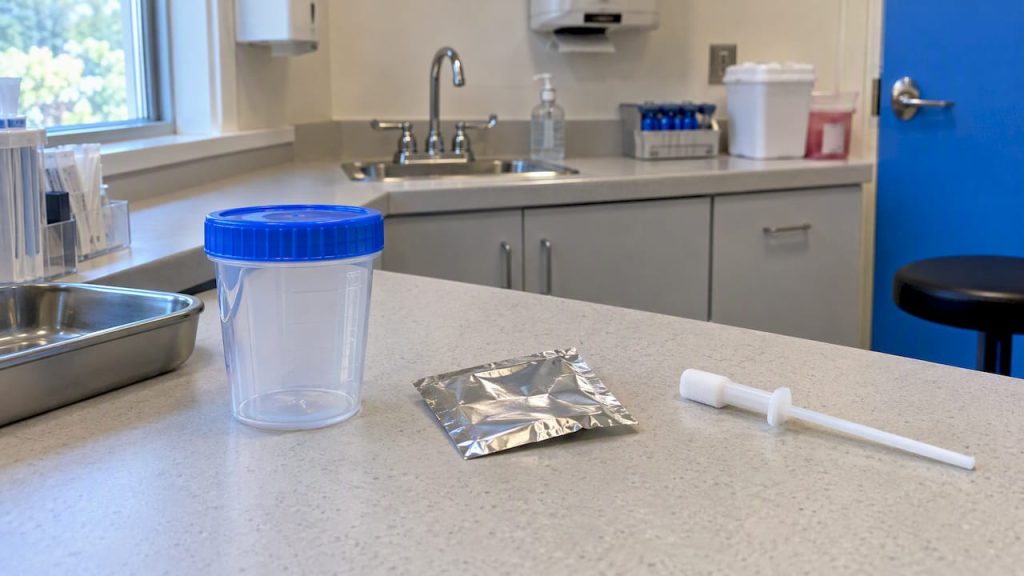
A Labcorp drug test runs in five stages: you check in with photo ID at a collection site, give a supervised specimen, the lab screens it by immunoassay, any presumptive positive is confirmed by mass spectrometry, and a Medical Review Officer (MRO) reviews the result before your employer hears anything. Negative results often come back within a couple of days. Anything that needs review takes longer. Below, we walk through each stage for urine, hair and oral fluid tests, with the most attention on hair, because that is where preparation matters most.
TL;DR
- Bring a photo ID. The collector handles the specimen under chain of custody, so there is no unobserved step where you can fix a problem.
- Labcorp screens first with immunoassay and confirms presumptive positives with GC/MS or LC/MS/MS. Urine samples also go through validity checks for dilution, substitution and adulteration.
- Negative results typically take 24 to 48 hours. MRO-reviewed positives usually take 3 to 5 days. Oral fluid panels can take 4 to 7 days.
- Hair tests look back up to 90 days, so a hair test is a question of the past three months, not the past few days.
- Tell the MRO about every prescription. It is the most common way a defensible result becomes a verified positive.
Table of Contents
- Before you arrive: scheduling and what to bring
- The urine drug test procedure step by step
- How the lab tests the sample
- The hair follicle drug test process
- How Macujo Aloe Rid Shampoo fits into hair test preparation
- The oral fluid (saliva) test process
- Results timeline and the MRO interview
- Our perspective: preparation beats panic
- Get a plan for your test
- FAQ
- Sources
Before you arrive: scheduling and what to bring
Most employer-ordered tests start with an instruction from the employer or a third-party administrator, often with a time window to show up. Labcorp says it offers collections at more than 2,000 specimen collection sites across the US, and many of them handle urine, hair, oral fluid and rapid tests. Not every site does every type, so confirm that the location you pick offers the specimen your employer ordered.
Bring a government-issued photo ID, such as a driver’s license, along with any order or registration number your employer gave you. The collector uses these to start the chain of custody form, the paper trail that ties the specimen to you.
Two practical points:
- Go within the window your employer gave you. A missed deadline can be treated as a refusal in some programs.
- List your medications before you leave home. You will want the names and doses ready if an MRO calls.
The urine drug test procedure step by step
Urine is still the most common specimen for pre-employment screening. Labcorp’s SAMHSA-certified labs run urine drug analyses under Department of Health and Human Services guidelines for federally regulated programs, and use similar controls for non-regulated testing.
- Check-in. You show ID and sign the chain of custody form.
- Preparation. You are typically asked to leave jackets and bags outside the restroom and wash your hands. Collection protocols vary slightly by site and by whether the test is DOT-regulated.
- Collection. You provide the specimen into a cup. The collector checks the temperature and appearance right away.
- Sealing. The specimen is sealed with tamper-evident tape and you initial it. It is split into two bottles in federally regulated collections, so a second bottle is available for retesting.
- Shipment to the lab. The sealed specimen travels with its paperwork.
- Lab testing. The lab screens and, if needed, confirms.
One thing readers often get wrong is the temperature check. A cup that reads outside the expected range is a red flag by itself, which is covered in detail in our guide to how labs judge urine test validity.
How the lab tests the sample
Labcorp describes a two-tier approach. The first tier is an immunoassay, which uses antibodies to flag broad classes of drugs. Anything that screens presumptive positive moves to the second tier, where GC/MS or LC/MS/MS identifies specific metabolites at defined cutoff levels. Immunoassay is a screen. The mass spectrometry confirmation is what gets reported as a positive.
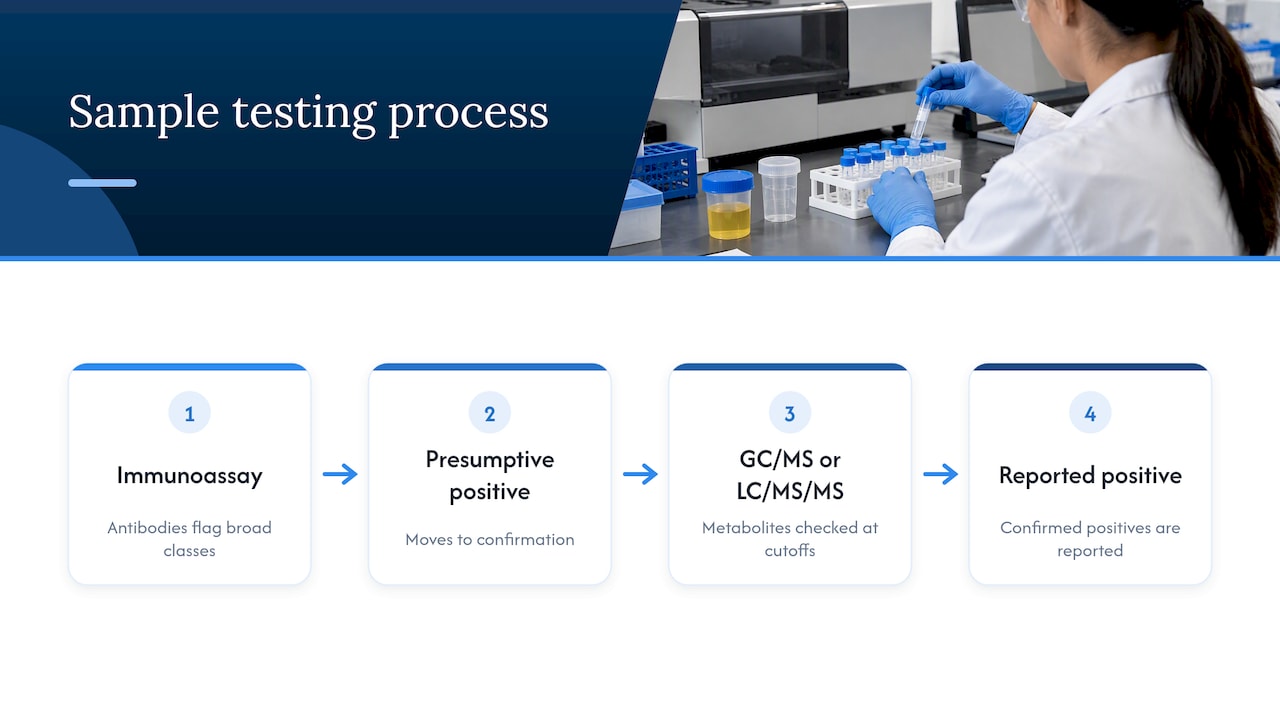
That matters for how you read your own situation. A screen alone does not decide anything, and a confirmation measures against a numeric cutoff in ng/mL. For federal programs, the THC urine cutoffs are 50 ng/mL for screening and 15 ng/mL for confirmation, which we break down in our page on SAMHSA cutoff levels. If you want the full picture of what happens in the confirmation step, see our walkthrough of the GCMS drug test.
Specimen validity testing
Urine is also checked for whether it looks like real, unaltered urine. Labcorp’s specimen validity testing analyzes creatinine, specific gravity, pH and nitrites to flag samples that are diluted, substituted or adulterated.
The common trap here is water. Laboratory guidance notes that diluted results are often flagged automatically, and a flagged sample can trigger a re-collection, sometimes directly observed. Drinking a large amount of water right before a test can therefore backfire. For what a negative-dilute means and how retests are usually handled, read our guide to a negative dilute drug test.
We will say this plainly: Labcorp checks for synthetic and substituted urine, and observed collections exist for exactly that reason. Do not assume any workaround will get past a lab’s validity panel.
The hair follicle drug test process
Hair testing is a different experience. Labcorp states that hair testing offers up to a 90-day detection window. The collector takes roughly a 100-milligram sample, about 90 to 120 strands, cut at the scalp, wraps it in foil and completes the chain of custody paperwork. Because the cut is made in full view of the collector, there is very little room for substitution.
On timing, Labcorp says hair specimens that screen negative are generally available within 48 to 72 hours of receipt. Initial screening is by immunoassay, with presumptive positives confirmed by mass spectrometry.
What this means if you are worried about a hair test
A hair test is not about whether you used something yesterday. It reflects a long stretch, and the answer to “how long until I’m clear?” depends on your own hair, your own history and the lab’s cutoffs. Nobody can honestly promise an outcome, and we won’t.
What you can control is your preparation. People who ask us about hair tests are usually in one of three positions:
- A job offer with a short timeline. The test is scheduled within days. See our page on pre-employment drug test laws for how hair fits into that picture.
- Random testing at work. The 90-day window matters, as we explain in our guide to random drug testing at work.
- Body hair as a substitute. If head hair is short or absent, labs can use other sites. We cover that in our article on the body hair drug test.
If your employer is DOT-regulated, hair is not an option for them at all. Urine and oral fluid are the only authorized specimens under federal DOT rules, and the employer has to pick one before the test starts. Our page on a DOT hair marijuana test explains the nuance for people who hear mixed information.
How Macujo Aloe Rid Shampoo fits into hair test preparation
Our approach to hair is built around the Macujo Method, a structured routine that uses a combination of products rather than one bottle. The Macujo Aloe Rid Shampoo is the cleansing step many of our hair customers start with. It is designed to be used on a schedule that depends on your hair and your test date.
Two things we want you to understand before you buy anything:
- No product is a guarantee. The lab’s result depends on what is in your hair and on the lab’s cutoffs. Results vary between people.
- Timing and technique matter as much as the product. That is why the Macujo Method comes with a wash calculator and step-by-step video instructions, and why we offer personalized help through a private consultation.
Our stated commitment is support until you pass your test, including unlimited consultations. If you are on a tight deadline, the best use of your first day is to work out your timeline, not to guess at one.
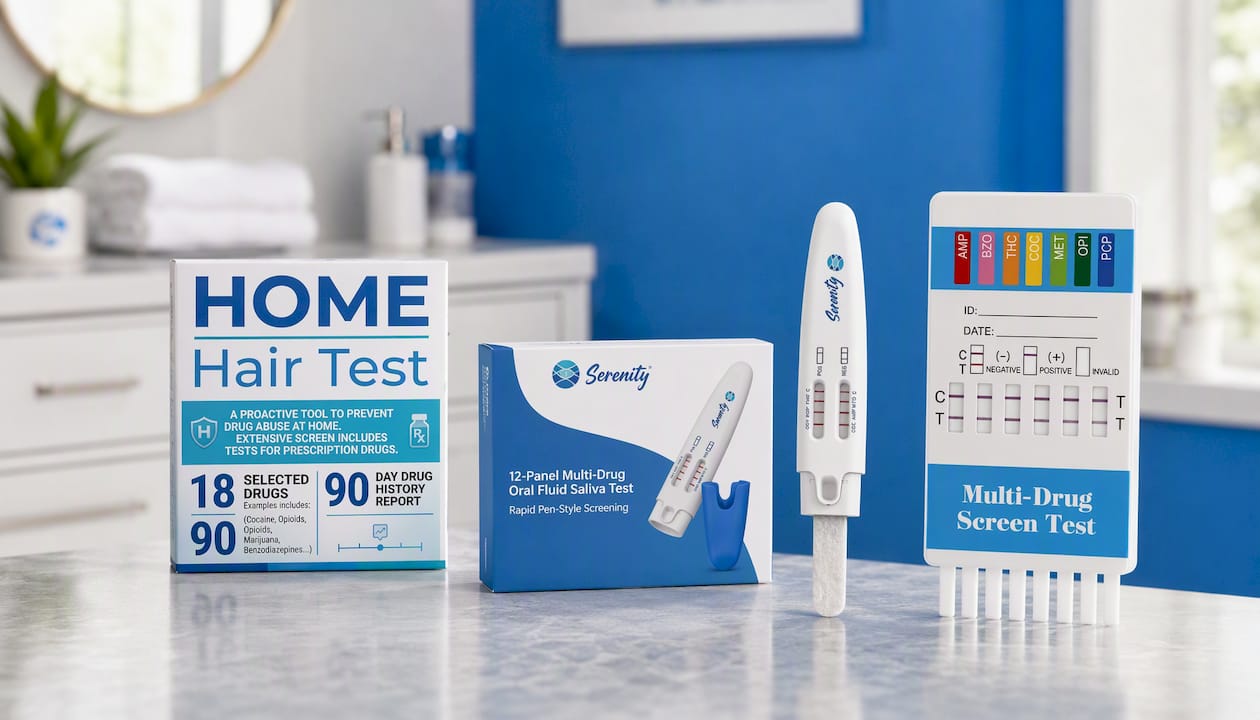
There is also a smarter first step for some people: find out where you stand. An at-home hair follicle drug test kit gives you information before you commit to a plan. It is a screening tool, not a lab result, so treat it as one data point.
The oral fluid (saliva) test process
Oral fluid collection is quick and observed. Labcorp’s oral fluid collector is described as a cellulose pad on a polypropylene stem placed under the tongue until a defined volume of saliva saturates the pad.
The step people overlook: donors must avoid food and drink for at least 10 minutes before collection, or the sample can be delayed or invalid. Do not smoke, chew gum or use anything in your mouth in the lead-up either.
Turnaround is longer than most expect. One Labcorp oral fluid panel lists 4 to 6 days, and a comprehensive oral fluid analysis lists 7 days from pickup to release.
Oral fluid generally reflects recent use, so preparation is a short-term matter. If you want to check yourself first, a 12-panel oral fluid saliva test gives a rapid read. For urine, a 13-panel urine dip card does the same job, and includes fentanyl.
Results timeline and the MRO interview
| Result type | Typical turnaround |
|---|---|
| Negative | 24 to 48 hours |
| Positive needing MRO review | 3 to 5 days |
| Oral fluid profiles | 4 to 7 days |
These figures come from Labcorp’s employee testing guidance. Your own timeline also depends on shipping, the employer’s process and how fast you respond to the MRO.
What the MRO does
When a lab reports a positive, a licensed physician, the MRO, reviews it. The MRO contacts you to ask whether there is a legitimate medical explanation, such as a prescription. The federal MRO guidance manual describes this interview as an essential part of the final review. It is not an automatic verdict.
The practical rule: if a doctor prescribed it, tell the MRO, and have the pharmacy label or physician’s note ready. Do not wait to be asked twice. Missing calls from an unfamiliar number is a quiet way to lose this step, so answer or return calls promptly.
Our perspective: preparation beats panic
We have spent more than 20 years helping people through drug tests, and the same pattern repeats. The people who feel worst are those who learned the process the night before. The people who feel steadiest knew three things: which specimen they were facing, how far back it looks, and what they could change before the collection.
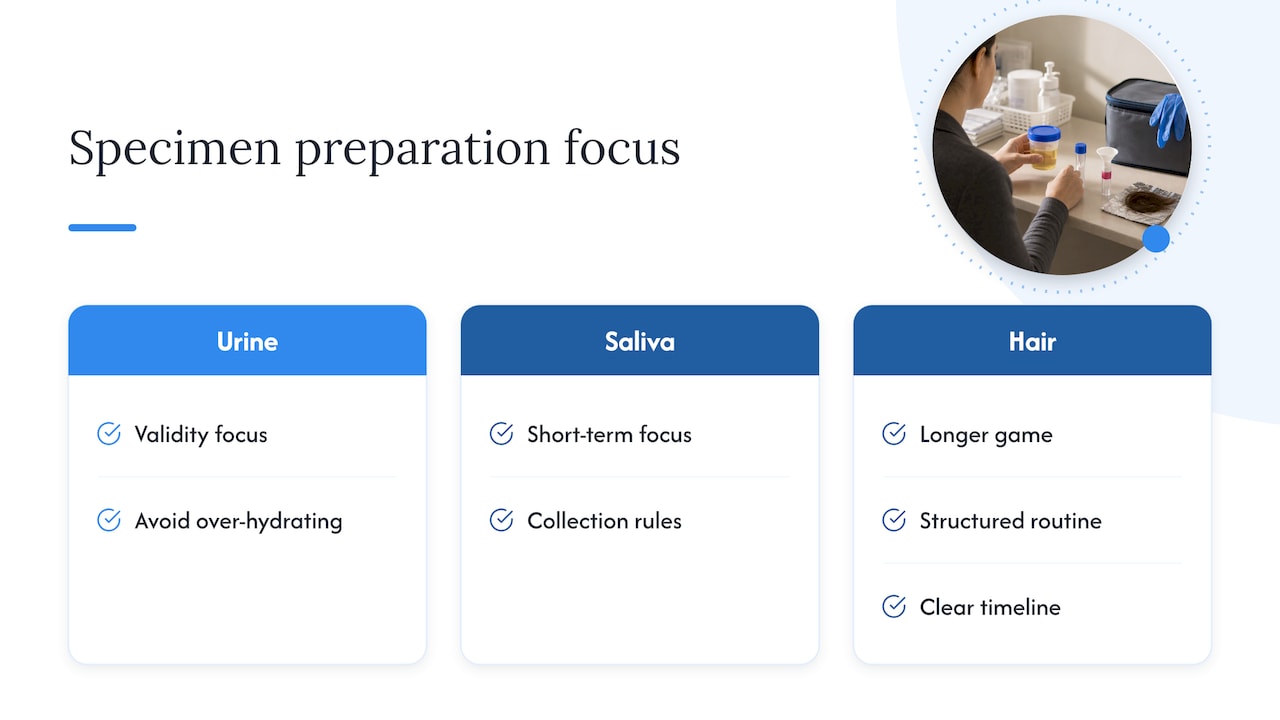
For urine, the controllable factors are mostly about validity: do not over-hydrate, and do not rely on anything the lab is built to detect. For saliva, it is short-term and about the collection rules. For hair, it is a longer game, and that is where a structured routine and a clear timeline do the most good. That is why the Macujo Method gives you a calculator, videos and a person to talk to rather than a single product and a hope.
We also believe in honesty about limits. We will tell you if your timeline looks tight, and we would rather you plan with real information than buy something you do not need.
— Detox Experts
Get a plan for your test
If you have a hair follicle test coming, start with our Hair, Urine and Saliva test products to see the Macujo Aloe Rid Shampoo and the rest of the routine. If you want someone to build the schedule around your hair and your date, book a private consultation with Mike Macujo.
FAQ
How long does Labcorp take to process a drug screen?
Negative results typically take 24 to 48 hours, according to Labcorp’s guidance. Positives that need MRO review usually take 3 to 5 days, and oral fluid panels can run 4 to 7 days. Hair negatives are generally available within 48 to 72 hours of the lab receiving the specimen.
What method does Labcorp use for drug testing?
It uses immunoassay for the first screen and confirms presumptive positives with GC/MS or LC/MS/MS. Urine samples also get specimen validity testing, which looks at creatinine, specific gravity, pH and nitrites.
Does Labcorp test hair?
Yes. Many collection sites offer hair collection, though not every site does, so check before you go. The collector cuts about 100 milligrams of hair at the scalp, and the test covers up to 90 days. DOT-regulated employers cannot use hair.
What happens if my result is positive?
An MRO, a licensed physician, contacts you before your employer gets a verified result. You can explain any prescription or medical reason and provide documentation. Keep your pharmacy records handy and return the MRO’s call quickly.
Sources
- Labcorp: Specimen collection services
- Labcorp: Urine drug testing
- Labcorp: Testing methodology FAQ
- Labcorp: Urine specimen guidelines
- Labcorp: Hair drug testing
- US DOT: 49 CFR 40.210
- Labcorp Diagnostics Update, October 2025
- MedTox: Drug Analysis, Comp, Oral Fluid
- Labcorp: Drug Abuse Profile, Oral Fluid
- Labcorp: Understanding the employee drug testing experience
- SAMHSA: MRO Guidance Manual 2024