


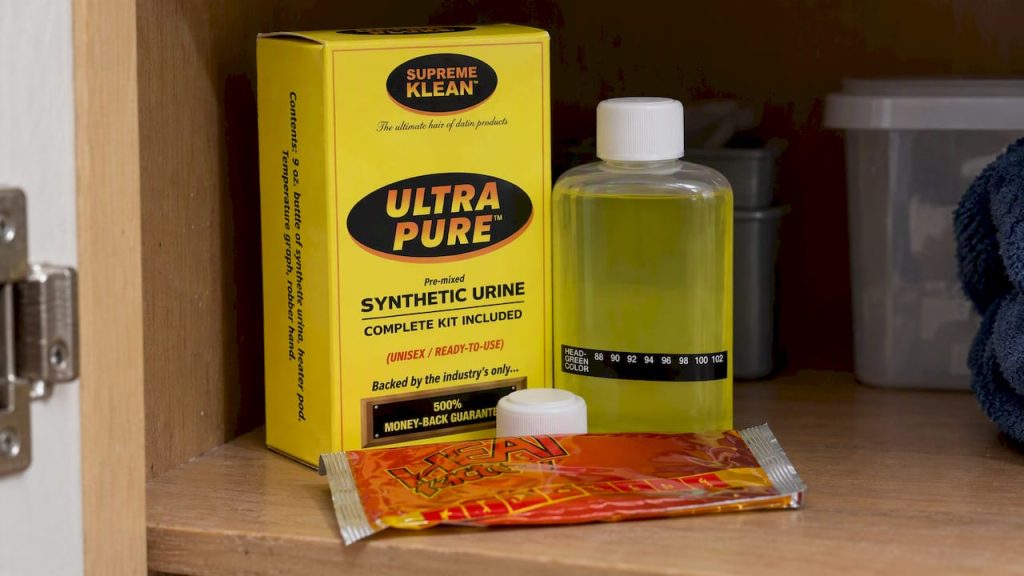
Yes, synthetic urine expires. Manufacturers commonly print a shelf life, but a laboratory stability study found that key markers can drift out of tolerance within 21–28 days under uncontrolled heat and light. Check the expiration date and batch number on your kit, and store it cool and dark.
TL;DR:
- Manufacturer labels typically list a shelf life of 6 to 24 months, but that period assumes recommended storage and depends on the product’s batch.
- A laboratory study found that uncontrolled heat and ultraviolet light lowered creatinine by about 9.3% and uric acid by about 13.7% after 30 days.
- Sealed powder generally keeps longer than premixed liquid, but adding water exposes it to degradation from heat, light, and air.
- Appearance and pH checks cannot confirm marker levels; when a product’s date or storage history is uncertain, the article recommends replacing it.
Table of Contents
- How long does synthetic urine last on the shelf?
- What damages synthetic urine: heat, light, oxygen, and packaging
- Sealed versus opened premixed synthetic urine
- Powdered synthetic urine: before and after mixing
- How to tell if synthetic urine has gone bad
- What labs check in specimen validity testing
- Our view: why storage and batch dates matter more than hope
- Fresh, in-date kits you can order from us
- FAQ
- Sources
How long does synthetic urine last on the shelf?
When people ask how long synthetic urine lasts, they usually want one number. The honest answer is a range. Manufacturer labels often span roughly 6 months to 24 months, and a sealed product stored the way the instructions describe usually reaches the upper end of what is printed. A bottle left in a hot car or a sunny window is a different story.
That printed date is a conservative promise, not a guarantee of how the product behaves in your hands. Manufacturers typically use different kinds of testing:
- Real-time stability testing: samples sit under recommended storage conditions and are measured at set intervals, which is slow but reflects normal life.
- Accelerated stability testing: samples are stressed with heat and light so makers can predict long-term behavior faster, then the printed date is set with a safety margin.
- Batch-based dating: the expiration is tied to a manufacturing lot, which is why the batch number matters as much as the date.
- Conservative labeling: makers print a shorter life than the best-case result so a product that sat in a warehouse is still within spec.
The gap between the printed life and real-world behavior shows up when storage goes wrong. A laboratory stability study found that creatinine and uric acid, the most fragile markers, can leave acceptable limits in as little as 21–28 days under uncontrolled conditions. A date on a label tells you what the product can do under good conditions. It says nothing about the month your kit spent in a glove box.
So treat the expiration date as a ceiling. Storage decides whether you ever reach it, and the next section explains what pushes a product off that path.
What damages synthetic urine: heat, light, oxygen, and packaging
Several things can contribute to damage, including temperature, ultraviolet light, oxygen, and the container itself. Temperature and UV are the dominant stressors for creatinine and uric acid, the two markers a lab leans on most when it judges whether a specimen looks like real urine.
A 30-day combined thermal and UV stress protocol lowered creatinine by about 9.3% and uric acid by about 13.7%. Those drops sound small, but they add up when a lab compares your sample against fixed cutoffs.
Here is what each factor does and what you can do about it:
- Heat: warm storage speeds up chemical breakdown. Keep your kit at a steady, moderate room temperature, not in a car, a bag in the sun, or next to a heater.
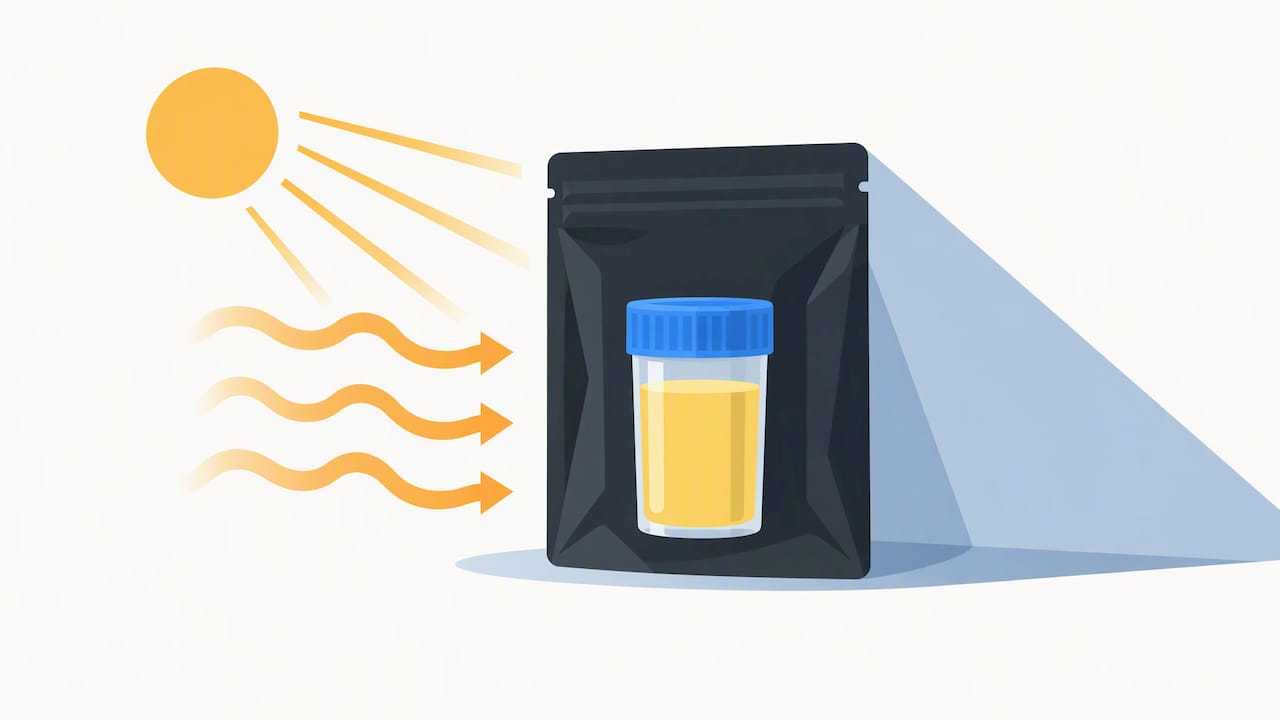
- UV and sunlight: light degrades uric acid and creatinine. Amber or opaque packaging reduces UV-induced losses, so avoid clear vials and keep the product in its box.
- Oxygen: every time a container is opened, fresh air gets in. An open container is at greater risk than a sealed one.
- Temperature cycling: repeated warming and cooling accelerates change, so do not move a bottle between the fridge and a warm room again and again.
- Long transport without control: shipping or carrying a kit for days without protection from heat and sun undoes careful storage at home.
The pattern across these factors is the same: stability is a storage problem more than a time problem. Identical bottles from the same batch can behave very differently over time if one lived in a drawer and the other lived in a backpack.
If you are buying a fresh kit, look at the packaging first. A product sold in protective, light-blocking packaging starts with an advantage that no home trick can fully replace. And whatever you own right now, move it somewhere cool and dark today.
Sealed versus opened premixed synthetic urine
A sealed premixed bottle follows the printed expiration date. Stored cool and dark, an unopened product usually reaches its labeled shelf life, so for a sealed kit your main job is to protect it from heat and sunlight and to read the date.
An opened bottle is a different case. Once air gets in, the clock tightens, and analyte drift becomes a real risk, especially if the bottle sits in uncontrolled conditions. If an opened bottle has spent an extended period in warm or bright surroundings, the safest move is to discard it and use a fresh one instead of hoping it held up.
Use this routine to handle any premix you own:
- Check the batch or lot number against the expiration date before you do anything else.
- Note the day you opened it on the label or the box so you are not guessing later.
- Reseal tightly right after use and return it to a cool, dark place.
- Avoid repeated temperature cycling, which stresses the formula each time it warms and cools.
- Keep it away from sunlight, including a bright windowsill or a car dashboard.
Pro Tip: Write the opening date on a piece of tape on the bottle the moment you break the seal. A date you can see beats a date you try to remember.
Think about how this plays out in real life. Someone buys a kit, opens it to look at the contents, tucks it in a drawer near a window, and finds it later. The seal is gone, the light has been hitting the box, and the product has gone through daily warming. That kit is not the one you bought, and the label no longer describes it.
If you cannot say with confidence where an opened bottle has been, treat it as spent. A fresh, sealed kit costs far less than the problems a degraded sample can create.
Powdered synthetic urine: before and after mixing
Sealed powder generally outlasts premixed liquid, as long as it stays dry and sealed. Manufacturers usually give dry goods a long printed shelf life because there is no water to carry out slow chemical reactions. Moisture is the enemy here, so a damp cabinet or a torn packet shortens that life quickly.
Mixing changes the rules. Once you add water, the solution picks up the same weaknesses as a premixed liquid: heat, light, and air start working on it. Store a mixed batch cool and dark, and use it promptly instead of treating it like a product with a shelf life.
Good mixing habits protect the result:
- Use clean, filtered water at the temperature the instructions recommend, since impurities and the wrong temperature both affect how the powder dissolves.
- Mix in a clean, opaque container so light does not reach the solution while it sits.
- Note the mix date on the container so you always know how old the solution is.
- Measure carefully and stir until the powder is fully dissolved with nothing settled at the bottom.
- Do not reuse leftover mixed solution after extended storage. Make a fresh batch when you need one.
A common mistake is mixing early “to be ready.” People prepare a batch days in advance, leave it in a clear container on a counter, and assume the powder’s long shelf life carries over. It does not. The long life belongs to the dry product, and it ends when the water goes in.
If you like to plan ahead, plan the purchase, not the mix. Keep powder sealed and dry until you need it, then prepare it fresh with clean tools.
How to tell if synthetic urine has gone bad
You can catch gross problems at home, but you cannot confirm that a sample is still in spec. Use this checklist before trusting any kit or bottle:
- Look at the liquid. Unusual cloudiness, separation, floating particles, or a color that looks different from when you bought it means discard it.
- Smell it. An off or sour odor is a reason to throw the product away.
- Check the date and batch number. If the printed expiration has passed, do not gamble on it.
- Think back through storage. Heat, sun, or an opened seal for weeks all count against it.
- Use a temperature strip and a basic pH strip to flag obvious problems, then accept their limits.
- Contact the manufacturer if you have any batch or storage concern, and avoid using a sample with questionable markers.
The limits matter. Toxicology experts caution that visual checks and pH strips miss subtle degradation of analytes like creatinine, and that expired or poorly stored synthetic urine often leads to invalid or substituted specimen flags. They also recommend products with verified batch dates and warn against third-party resellers.
Creatinine and uric acid are the most fragile markers, and a roughly 9.3% creatinine drop in 30 days under thermal and UV stress can make a sample look diluted. You cannot see that happen.
That is the uncomfortable truth about home checks. A bottle can look perfect, smell fine, and read a normal pH while its creatinine has slipped. A lab does not judge by eye. It measures, and low creatinine or abnormal specific gravity is exactly what produces a diluted or substituted flag.
So use the checklist to rule out the obvious, and let the date, the batch number, and honest storage history make the real call. When any of those is uncertain, replace the product. For deeper operational guidance on warming and use, see our guide on how to use synthetic urine.
What labs check in specimen validity testing
Specimen validity testing, or SVT, is how a lab decides whether a sample looks like human urine before it ever reads the drug result. Standard panels measure creatinine, specific gravity, pH, and oxidants. Laboratory guidance lists typical cutoffs of creatinine above 20 mg/dL and specific gravity between 1.003 and 1.035, and the Tox In Focus overview describes the same thresholds.
Here is how degradation connects to those flags:
- Lower creatinine from poor storage can push a specimen under the cutoff, and the same clinical guidance notes it can mimic dilution and lead to a “diluted” or “substituted” label instead of a plain drug-screen result.
- Shifted specific gravity outside the accepted range raises the same concern.
- Abnormal pH or oxidant readings add to the picture and draw further scrutiny.
- Extra biomarkers such as urea, uric acid, GGT, and amylase can improve detection of synthetic samples, according to analyses of synthetic urines and adulterants, though not every lab uses them.
The stability research ties these threads together. Packaging is not a cosmetic detail. It changes how fast the numbers move.
Experts recommend products with verified batch dates, because expired or poorly stored synthetic urine often leads to invalid or substituted flags.
What should you do with this? Be conservative. If a kit has been through uncontrolled storage, such as weeks of heat or light, do not assume it still meets the numbers a lab applies. Discard it and start with a fresh, in-date product. If you are unsure about a batch, contact the manufacturer. If you want to understand how temperature and other markers are judged, our breakdown of urine test validity checks covers the reasoning in more depth.
Our view: why storage and batch dates matter more than hope
Our core focus is hair testing, and our Macujo Aloe Rid Shampoo is built around helping you prepare your hair before a follicle test. We also support urine and saliva situations, and we see the same mistake across all of them: people trust a product they have not checked.
With synthetic urine, that mistake is quiet. The bottle looks fine, so it gets used, and a drifted creatinine level does the damage. Our advice is simple. Use fresh, in-date kits, verify the batch number, and keep the product cool and dark until the day you need it. If your timeline is tight and you are unsure what to buy or how to prepare, book a private consultation with Mike Macujo and we will work through your situation with you.
For readers who want more, start with our pages on urine test validity checks and how to use synthetic urine. A kit is only as reliable as the care it received.
— Detox Experts
Fresh, in-date kits you can order from us
If your current kit is old, opened, or stored badly, replace it with one that is sealed and in date. We carry the Ultra Pure family so you can match the quantity to your situation.
- Ultra Pure Synthetic Urine Kit – Laboratory Grade Formula: our premixed laboratory formula for a single, ready-to-use kit.
- Ultra Pure Synthetic Urine Kit – Laboratory Grade (Multi-Pack Bundle): a multi-pack for people who need more than one kit or recurring supply.
- Ultra Pure Synthetic Urine Kit: a compact option.
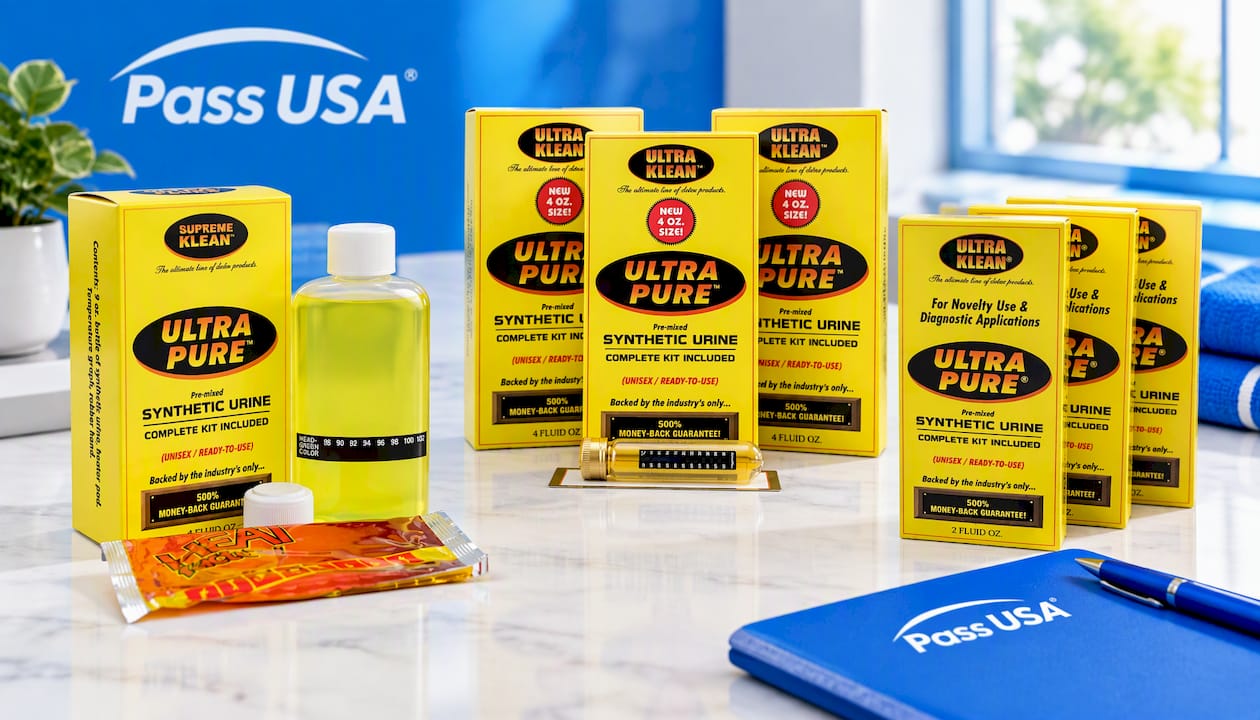
Our advice on buying is practical. Check the expiration and batch details before you commit, and prefer stock sold directly by the manufacturer over third-party resellers. If you will need kits again, a multi-pack saves you from reordering at the last minute. Browse the full Ultra Pure product page for details. If your test is close and you want help choosing a kit for your situation, book a private consultation, or look through everything we carry for hair, urine, and saliva at PassUSA.
FAQ
Can I reuse synthetic urine after 24 hours?
It is safer not to. Once a sample is mixed or warmed, it is exposed to heat, light, and air, and leftover solution can drift from its original markers. Prepare a fresh sample for each use instead of saving a leftover one.
How long can a lab keep a urine sample before it goes bad?
It depends on the analyte and the conditions, because drug stability in urine is highly temperature- and pH-dependent. Some compounds degrade quickly at elevated temperatures. Labs manage this with controlled storage.
How do I know if my synthetic urine is expired?
Start with the printed expiration date and batch number, then think about how it was stored. Cloudiness, separation, or an off odor mean discard it, but a normal look does not prove it is fine. If storage was uncontrolled, replace it.
Can labs tell if urine is synthetic?
Sometimes. Standard validity panels do not catch every synthetic product, but additional biomarker panels can improve detection, and degraded samples are more likely to draw an invalid or substituted flag.
Sources
- Assessment of Thermal and UV Stability of Synthetic Urine Under Chain-of-Custody Conditions: A Repeated-Measures Analysis of Compositional Changes Over Thirty Days – Scimetr
- Sample validity lessons learned from challenging cases and proposed biomarkers for synthetic urine detection | Journal of Analytical Toxicology | Oxford Academic
- A Practical Guide to Urine Drug Monitoring – PMC
- SYNTHETIC URINES AND ADULTERANTS