


Abstinence combined with time for new hair growth is the only strategy the evidence supports as reliable for a THC hair test, since labs sample the segment of hair closest to the scalp to capture roughly the last three months of exposure. When notice is short, a Macujo-based pre-test regimen can measurably lower detectable THC in some studies, though results vary and are never guaranteed. Private at-home testing before the real exam is the smartest way to know where you stand.
TL;DR:
- THC metabolites become embedded in hair through systemic incorporation, with darker hair retaining more due to melanin affinity, affecting test outcomes.
- Decontamination steps like solvent washes and LC-MS/MS confirm internal THC-COOH levels, making surface treatments ineffective at altering results.
- Laboratory research indicates repeated, multiple-step chemical treatments can reduce THC levels by up to 90%, but only with long-term application, not a single rinse.
- Abstinence for at least three months aligns with hair growth math, offering the most reliable way to clear THC from the tested segment.
- Private at-home testing before the official exam provides the best chance to gauge your current THC levels and the potential effectiveness of detox methods.
Table of Contents
- How hair follicle THC testing works: metabolites, incorporation, and lab confirmation
- Peer-reviewed evidence: which treatments lower THC in hair and what the limits are
- Step-by-step pre-test prep: safe, prioritized actions
- Unreliable shortcuts, detectable tampering, and safety and legal risks
- How long it takes: hair growth math and realistic timelines
- PassUSA credentials and how our protocol aligns with the evidence
- What the research actually tells you to prioritize
- Getting started with PassUSA’s products and consultations
- Sources
- FAQ
How hair follicle THC testing works: metabolites, incorporation, and lab confirmation
Hair testing works differently than urine or saliva screening because it targets a longer memory of drug exposure. As hair grows, blood vessels at the root deliver compounds circulating in the bloodstream into the growing shaft, where THC and its metabolites become locked into the keratin structure. That process, called systemic incorporation, is separate from surface contamination, which happens when hair simply touches smoke or residue in the environment without any of it entering the bloodstream.
This distinction matters because labs specifically look for THC-COOH, a metabolite the body only produces after THC is metabolized internally. Finding the parent compound alone on the hair shaft is not proof of use, since it could come from secondhand exposure. Finding THC-COOH is a much stronger indicator, because contamination alone rarely produces it in meaningful amounts. Confirmatory testing relies on liquid chromatography tandem mass spectrometry, or LC-MS/MS, a method sensitive enough to distinguish the metabolite from background noise and confirm results flagged by an initial screening.
Hair color and structure also affect how much THC ends up trapped in the strand. THC is lipophilic, meaning it binds readily to fat and to melanin, the pigment protein in hair. Darker, more pigmented hair tends to retain more THC than lighter hair, which is one reason two people with identical use patterns can produce different test results.
Standard practice samples the proximal segment, the 1 to 3 centimeters closest to the scalp, because hair grows at a fairly predictable rate of about 1 centimeter per month. That segment corresponds to roughly the past one to three months of exposure, which is where the widely cited 90-day detection window comes from.
Before any of that analysis happens, labs run a decontamination step designed specifically to strip away surface residue and rule out external contamination as an explanation for a positive result. According to SAMHSA guidance on drug metabolites and hair testing, this typically involves:
- An initial wash using isopropanol or a similar organic solvent to remove surface oils and residue.
- A secondary buffer or solvent rinse to further separate external contamination from what is actually incorporated into the hair matrix.
- Pulverization or enzymatic digestion of the hair sample, breaking down the keratin structure so metabolites trapped inside the shaft can be extracted.
- Confirmatory analysis by LC-MS/MS, which measures the exact concentration of THC-COOH against a validated cutoff.
That sequence is exactly why a quick rinse the morning of a test accomplishes very little. The lab’s own decontamination wash is designed to remove precisely the kind of surface residue a last-minute product might leave behind, before the sample is ever broken down and analyzed for what is actually inside it.
Peer-reviewed evidence: which treatments lower THC in hair and what the limits are
Independent research on hair detox treatments exists, and it paints a more complicated picture than either “nothing works” or “anything works” claims suggest. A 2022 peer-reviewed study published in PMC measured how several commercially available products affected THC concentrations in treated hair samples under repeated laboratory wash conditions.
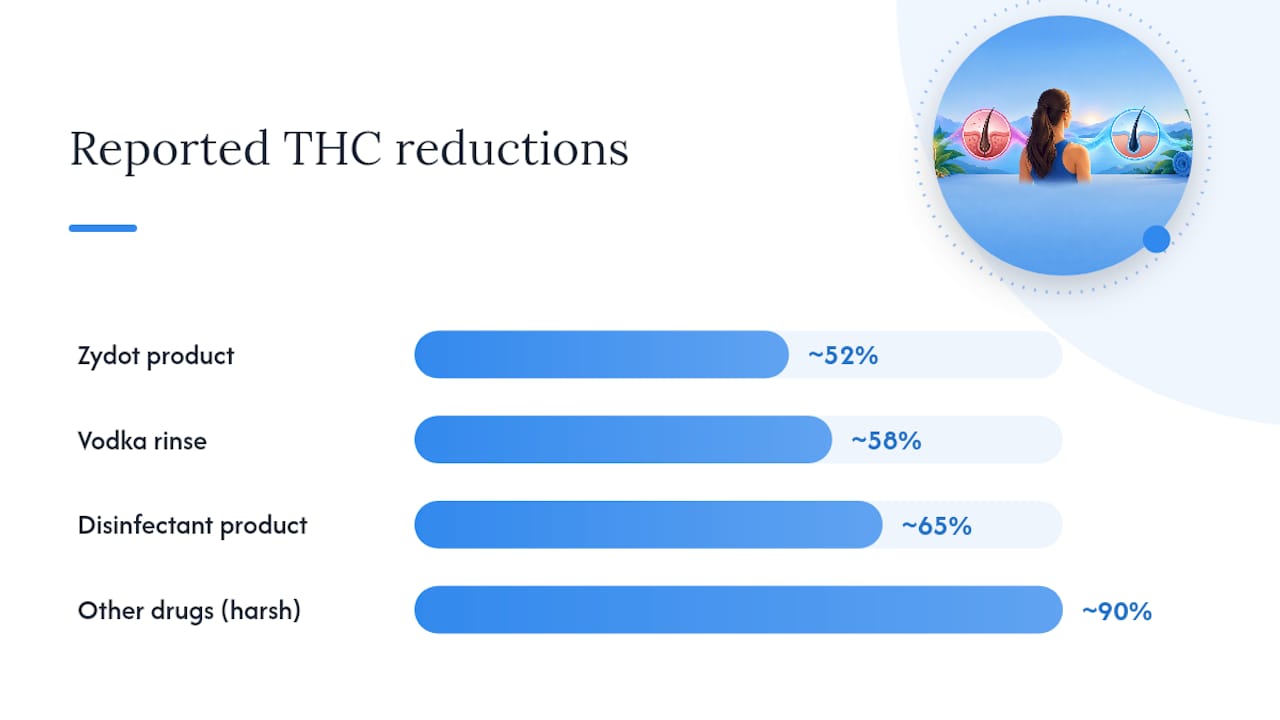
One 2022 study found mean THC reductions ranging from about 52% to 65% depending on the product tested, with Zydot-based treatment producing roughly a 52% reduction and a disinfectant-based product producing closer to 65%, while a vodka-based rinse landed near 58%. Those figures came from hair strands subjected to repeated, long-duration exposure in a controlled lab setting, not a single at-home wash the night before a test. The study’s authors noted that the significance of the reduction varied by product and protocol, and that in vitro results do not map cleanly onto every real-world hair type or use pattern.
A second, separate study published in Drug Testing and Analysis in 2023 tested homemade multi-step treatments, including combinations of baking soda, salicylic acid, and bleach, along with dyeing cycles and vinegar-based cleaners. That research found:
- Drug concentration decreases across many analytes tested, with some substances dropping by as much as 90% under the harshest protocols.
- THC reductions that were real but generally smaller than reductions seen for other drugs, meaning THC is comparatively more resistant to chemical stripping.
- Bleaching and dyeing cycles can reduce THC levels in hair in some cases, especially when applied repeatedly and aggressively.
The pattern across both studies is consistent: the treatments that produce meaningful reductions are the ones applied repeatedly, over time, using stronger chemical exposure than a single wash provides. A one-time application the night before a test bears little resemblance to the multi-week, multi-cycle protocols used in the research. That gap between lab conditions and real-world timelines is exactly why treatments described here work best as part of a structured plan, not a last-minute fix.
This is also why forensic and toxicology groups lean so heavily on confirmatory metabolite testing rather than trusting a visual or surface check alone. THC-COOH concentrations, measured against a validated cutoff and confirmed by LC-MS/MS, are far harder to manipulate than surface appearance. Consensus guidance from hair testing bodies recommends validated decontamination and metabolite-based confirmation specifically because surface treatments and cosmetic changes can look convincing while leaving the underlying metabolite signature largely intact.
Step-by-step pre-test prep: safe, prioritized actions
If you have a hair follicle test coming up, the order you take action in matters as much as what you do. Here’s a prioritized sequence based on how the evidence actually holds up.
- Start abstinence immediately and calculate your timeline. Count backward from your test date using roughly 1 centimeter of hair growth per month, since that math determines how much of the detection window you can realistically influence.
- Get a private at-home screening before you rely on any plan. The At-Home Hair Follicle Drug Test Kit lets you preview your likely result under low-stakes conditions, which is far better than guessing and finding out the hard way at an official screening.
- If time is short, follow a structured Macujo-based regimen rather than a single product application. This is where Zydot Ultra Clean Shampoo fits into a broader protocol involving repeated, carefully timed washes rather than a one-off rinse, echoing the repeated-exposure conditions seen in the research above.
- Follow the wash sequence exactly, including saturation time and rinse intervals, since studies showing meaningful reductions used consistent, repeated application rather than a rushed single pass.
- Avoid extreme bleaching or chemical stripping without professional guidance. Harsh, unsupervised bleaching can damage hair, may produce inconsistent results, and in some cases raises questions during collection if hair looks visibly altered.
- Consider a paid consultation if your situation is complicated by hair length, hair type, frequency of use, or a compressed timeline, since a generic routine does not account for those variables the way a personalized plan can.
Pro Tip: Run your at-home test at least a few days before any structured wash routine, then again afterward, so you have a real before-and-after comparison instead of relying on assumptions.
For readers who want more detail on how the broader protocol is structured, PassUSA’s guide on successful ways of passing a hair drug test walks through the product sequencing in more depth. Those with additional questions about how testing labs evaluate marijuana specifically can also review the background on hair follicle drug testing for marijuana.
None of this replaces the fundamental math of hair growth and detection windows. A pre-test regimen can shift the odds in some documented cases, but it works within the limits the research describes, not beyond them.
Unreliable shortcuts, detectable tampering, and safety and legal risks
A lot of what circulates online about beating a hair test does not hold up once you compare it against how labs actually work. Single-use detox shampoos marketed as one-wash solutions run into the same problem: labs decontaminate the sample before extraction specifically to strip away surface treatments, so a product that only coats the hair shaft rather than penetrating it has limited ability to affect what gets measured inside the keratin matrix.
Bleaching and perming can reduce measurable THC concentrations, as the research above shows, but that reduction comes with real trade-offs.
- Aggressive bleaching cycles can visibly damage hair, which sometimes draws attention during sample collection and can prompt a request for an alternate specimen.
- Chemical treatments strong enough to meaningfully lower THC-COOH often affect hair structure enough to be noticeable, undermining the appearance of untreated, natural hair.
- Some labs respond to visibly altered or damaged samples by requiring a complementary urine test, which defeats the purpose of trying to manipulate the hair result alone.
- Because THC is comparatively resistant to chemical stripping compared to other drugs, the reduction achieved often falls short of what’s needed to change a result, especially for frequent users.
There is also a hard line that should never be crossed: substituting a sample, tampering with a specimen during collection, or attempting to submit hair that is not your own carries serious legal and employment consequences, separate from any question of whether it would even work. Collection procedures exist specifically to prevent substitution, and getting caught tends to carry far worse consequences than a positive result would have.
The honest takeaway from the research is that chemical manipulation has a ceiling. It can shift numbers under the right conditions, but it cannot reliably erase a strong use history, and attempting to force the issue through damage or substitution introduces risks that a slower, evidence-based approach avoids entirely.
How long it takes: hair growth math and realistic timelines
Hair grows at roughly 1 centimeter per month, and standard testing protocol samples the proximal 1 to 3 centimeters closest to the scalp, which is where the commonly cited 90-day detection window comes from. That math is the single most useful number for deciding your strategy.
| Time before test | Realistic strategy | Expected reliability |
|---|---|---|
| Less than 2 to 3 weeks | Private pre-testing plus a structured Macujo-based prep regimen | Limited by growth math; results vary |
| 4 weeks | Abstinence combined with prep regimen and repeated at-home screening | Improves as new, unexposed hair grows in |
| 3 months or more | Abstinence alone, allowing full hair growth cycle to clear the tested segment | Most reliable option supported by the evidence |
If your window is under two or three weeks, your options are genuinely limited. A private screening tells you where you stand, and a structured prep regimen may help at the margins, but the growth math cannot be rushed. If you have months rather than weeks, abstinence does the heavy lifting on its own.
It’s also worth deciding early whether hair testing is even the right specimen to worry about. Urine and saliva tests operate on completely different detection windows, typically measured in days rather than months, and call for different preparation entirely. PassUSA’s urine test products and saliva test products are built around those shorter windows, which matters if your upcoming screening is a random urine check rather than a hair panel.
PassUSA credentials and how our protocol aligns with the evidence
There is over two decades of experience building detox products and protocols specifically around drug testing scenarios, with a product line built on the Macujo Method rather than generic detox marketing. That history matters because the regimen described in this guide isn’t a one-off product pitch, it’s the same structured, repeated-application approach that the peer-reviewed research above associates with measurable reductions, applied consistently over two decades of customer use.
A few specifics worth knowing:
- The product catalog covers hair, urine, and saliva testing scenarios, so the guidance here connects directly to purchasable options rather than generic advice.
- Private consultations give customers a personalized plan based on hair length, hair type, and timeline, rather than a one-size-fits-all instruction sheet.
- The company’s hair follicle drug testing resources are built to explain, not just sell, which is why the limitations covered in this guide are stated plainly rather than glossed over.
None of this amounts to a guarantee. PassUSA is upfront that success depends on variables the research itself identifies, including how much time is available, hair type, and how consistently a regimen is followed. The responsible next step for most readers is a private at-home test to establish a real baseline, followed by a conversation with a consultant if the timeline or hair type is anything but straightforward.
What the research actually tells you to prioritize
The most overrated part of this whole topic is the single miracle product. The studies reviewed here consistently show that meaningful reductions come from repeated, structured exposure over time, not a one-time rinse the night before a test, and yet most of the search results built around this topic still frame it as a single-product fix.
What conventional advice underplays is how much the math of hair growth outweighs any product’s effect. A regimen can shift the odds at the margins, but it operates inside limits that abstinence and time simply don’t have. If you take one thing from this guide, make it this: test yourself privately before you rely on anything else. A private screening turns guesswork into information, and information is what actually changes outcomes here, not any single bottle on a shelf.
— Detox Experts
Getting started with PassUSA’s products and consultations
If your test is close and abstinence alone isn’t a realistic option, PassUSA’s product lineup gives you a concrete place to start. Zydot Ultra Clean Shampoo is built into the Macujo-based regimen described above and works best as part of that structured routine rather than a single wash. For heavier or repeated use, the Zydot Ultra Clean Shampoo 3-Pack supports the multi-session approach the research points to.
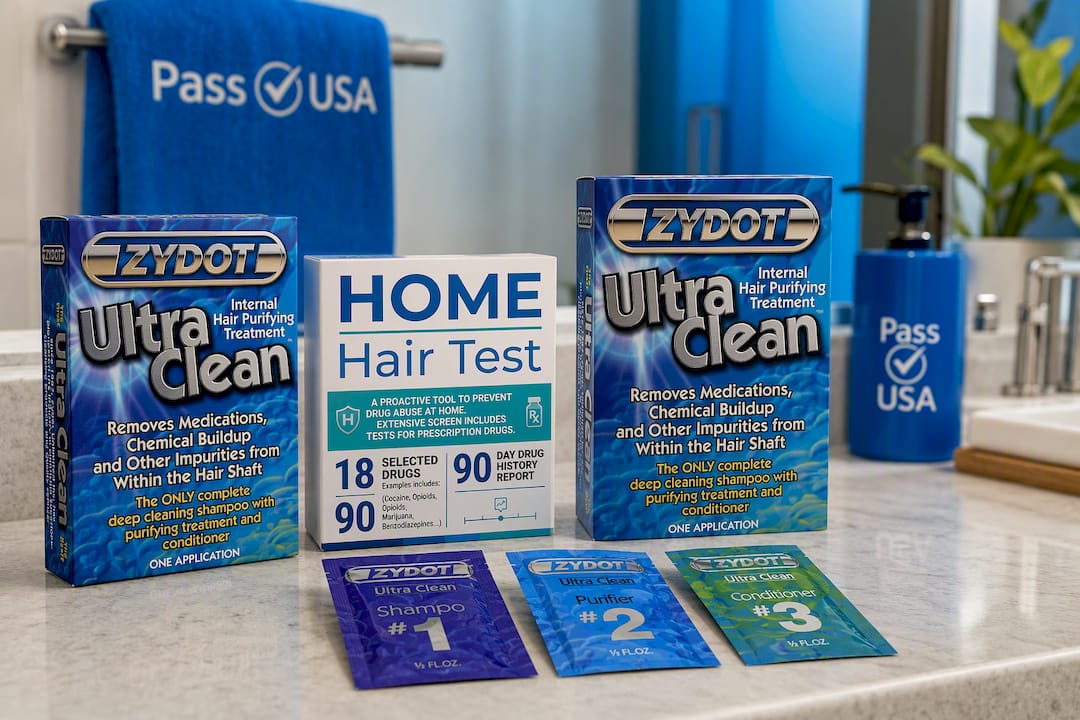
Before relying on any of it, the At-Home Hair Follicle Drug Test Kit gives you a private read on where you actually stand. And if your hair type, length, or timeline make your situation complicated, a private consultation with Mike Macujo builds a plan around your specifics rather than a generic routine. These products support the regimen outlined in this guide, and PassUSA is direct that results depend on your situation, not a fixed promise.
Sources
- Manipulation of THC Hair Concentrations by Commercially Available Products – PMC
- Hair analysis: Assessment of homemade hair treatment effects on drug concentrations in the keratin matrix
FAQ
How long does it take to detox your hair from THC?
Hair grows at roughly 1 centimeter per month, and standard tests sample the 1 to 3 centimeters closest to the scalp, covering about the past three months of exposure. Full abstinence for that period is the most reliable way to clear the tested segment, while shorter timelines rely on a structured pre-test regimen with more variable results.
What shampoo removes THC from hair?
No shampoo removes THC on its own with a single wash, since labs decontaminate samples before testing specifically to strip away surface treatments. Zydot Ultra Clean Shampoo is designed to work as part of a structured, repeated Macujo-based regimen rather than a standalone fix, echoing the repeated-exposure conditions studied in peer-reviewed research.
What is the best way to clear THC from my system?
For hair specifically, abstinence combined with the natural growth cycle is the most reliable approach the evidence supports. For urine or saliva, the relevant detection windows are measured in days rather than months, so the preparation and timeline look completely different from hair-based strategies.
What can throw off a hair follicle test?
Visible hair damage from aggressive bleaching or chemical treatment can prompt a lab to request an alternate sample, and severe cosmetic alteration can sometimes affect result interpretation. Environmental contamination alone rarely produces a positive result for the metabolite THC-COOH, which is the marker labs rely on to confirm actual use rather than surface exposure.