


Sauna sessions will not meaningfully speed up how fast your body clears THC, and they will not reliably help you pass a drug test. Controlled research found that sweat accounts for less than 1% of total THC elimination, so the bulk of THC leaves through liver metabolism and excretion, not perspiration. If a test is coming up, abstinence combined with matrix-specific preparation, especially for hair testing, is the approach with actual evidence behind it.
TL;DR:
- Controlled research found that sweat accounts for less than 1% of THC elimination, while liver metabolism and excretion do most of the work.
- Intense exercise or sauna sessions within about 48 hours of testing can release THC stored in fat and temporarily raise detectable levels.
- Urine tests detect THCCOOH over days to weeks, depending on use, while saliva tests generally reflect use within the past day or two.
- Excess water can temporarily lower urine metabolite concentration, but it does not speed clearance, affect hair results, and may prompt sample flagging.
Table of Contents
- What the research actually shows about sweat and THC clearance
- How your body actually clears THC from your system
- Why sweating in a sauna won’t clear stored THC
- When sauna use or exercise can backfire before a test
- How to prepare for a hair follicle test the right way
- Common myths about sauna detox for THC
- How sauna detox compares to other detox methods
- Why individual factors limit sauna detox effectiveness
- Using sauna sessions safely within a broader detox plan
- Repeated sauna sessions versus a single session
- A practical perspective on realistic expectations
- Matching PassUSA products to your test type and timeline
- FAQ
- Sources
What the research actually shows about sweat and THC clearance
A controlled study measuring THC in sweat found that this route accounts for less than 1% of total THC elimination, and the same research found no meaningful difference in clearance rates between people who used saunas and those who did not. That finding undercuts the popular idea that heavy sweating “flushes” cannabinoids out of the body.
- Sweat glands excrete mostly water, salts and a tiny fraction of trace compounds, not stored THC.
- Sauna users and non-users showed no significant difference in how quickly THC cleared their systems.
- Intense exercise or heat exposure close to a test can cause brief, temporary increases in detectable THC levels rather than faster clearance.
Less than 1% of total THC elimination happens through sweat, according to controlled excretion research, which means sauna sessions are addressing a pathway that barely matters to the overall timeline.
Separately, research on exercise and fat loss found that physical exertion or food deprivation can release fat-stored cannabinoids back into the bloodstream, producing short-lived spikes rather than permanent reductions.
How your body actually clears THC from your system
THC is lipophilic, meaning it binds readily to fat tissue rather than dissolving in water. Once stored in fat cells, it is gradually released back into the bloodstream and processed by the liver into metabolites, primarily THCCOOH, which then exit mainly through urine and feces. This is the real elimination pathway, and it has little to do with how much you sweat.
- Urine tests detect THCCOOH metabolites and reflect use typically within the past several days to weeks, depending on frequency of use.
- Saliva tests detect parent THC and reflect very recent use, usually within the last day or two.
- Hair tests incorporate THCCOOH into the hair shaft over time and can reflect exposure going back several months.
Because hair grows slowly and locks in chemical traces as it forms, hair testing requires laboratories to rule out external contamination. The Society of Hair Testing consensus notes that labs rely on THCCOOH specifically to distinguish actual ingestion from surface exposure, and they require validated washing and decontamination steps before analysis. That distinction matters for anyone trying to prepare for a hair test, since surface residue and incorporated residue require different cleaning approaches.
Why sweating in a sauna won’t clear stored THC
A sauna session raises your core temperature and makes you sweat heavily, but what comes out through your pores is mostly water, electrolytes and trace amounts of various compounds. It is not a significant exit route for the THC sitting in your fat tissue. The sweat excretion study backs this up directly: even with heavy perspiration, the share of THC leaving through skin is negligible compared to what the liver and kidneys process.
Saunas do improve circulation, and better blood flow can feel like it is “doing something.” But circulation alone does not change the hepatic Phase I and Phase II metabolic pathways that convert THC into THCCOOH and prepare it for excretion. Those pathways run on liver enzyme activity and time, not heat exposure.
- Heavy sweating removes water and electrolytes, not meaningful quantities of stored THC.
- Improved circulation from heat exposure does not accelerate liver metabolism of THC.
- Clinical sauna programs studied for chemical exposure recovery are structured, multi-week protocols, not single pre-test sessions.
One large prospective evaluation of sauna-based detoxification in residential treatment settings found the regimens were well tolerated and supported overall health, but those programs target long-term chemical exposure recovery over weeks, not rapid clearance before a scheduled test.
Pro Tip: If you are considering a sauna session before a test, think of it as general wellness, not a clearance strategy. It will not change your result timeline.
When sauna use or exercise can backfire before a test
Trying to “sweat it out” right before a test can actually work against you. Research on exercise and fat-stored cannabinoids found that physical exertion can release THC that was sitting in fat tissue back into your bloodstream, which can temporarily raise detectable levels instead of lowering them.
- Skip intense exercise or aggressive sauna sessions within about 48 hours of your test, since exertion can trigger temporary THC release from fat stores.
- Watch for dehydration signs, including dizziness, dark urine and headache, and rehydrate with water and electrolytes rather than excessive plain water.
- If your test is imminent, stop any cannabis use immediately, verify your status with an at-home test, and look into matrix-specific preparation instead of relying on heat exposure.
How to prepare for a hair follicle test the right way
Hair testing is the matrix where preparation actually matters most, because hair reflects a detection window of roughly ninety days rather than a few days. Time is the single biggest factor working for or against you here, so the earlier you stop use, the more that window works in your favor.
- Start abstinence as early as possible since hair records exposure over weeks and months, not hours.
- Check progress with validated at-home hair tests rather than guessing.
- Follow a documented washing and decontamination protocol rather than a single rinse.
- Understand that hair cleansing has to address both surface residue and residue incorporated into the hair shaft.
The Society of Hair Testing consensus describes how laboratories validate wash protocols specifically to separate surface contamination from what was actually incorporated into the hair during growth. That is the same logic behind targeted hair treatments: a surface rinse alone will not reach residue that has bonded to the hair shaft, which is why a structured, multi-step approach works differently than shampooing more often.
This is where our Macujo Aloe Rid Shampoo fits into a realistic plan. We offer it as part of the Macujo Method, used as one step within a hair-cleansing protocol rather than a single wash. We offer hair-cleansing guidance based on that same idea: abstinence first, testing to track progress, and a structured hair-cleansing protocol before your test date.
Pro Tip: Follow the wash steps in order and for the full recommended duration. Skipping steps or rushing the protocol is the most common reason a hair-cleansing plan underperforms.
Common myths about sauna detox for THC
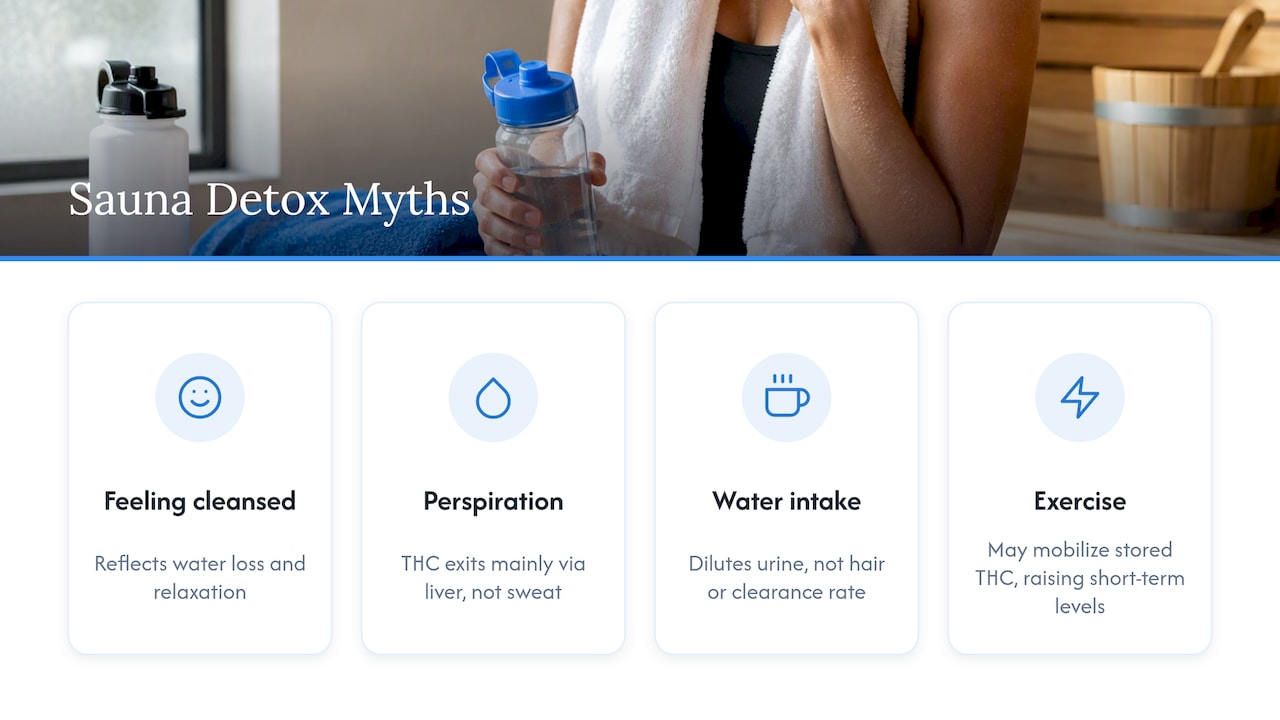
A lot of what circulates about sauna detox comes from confusing “feeling cleansed” with actually clearing a drug from your system. A hard sweat session can leave you feeling lighter and more energized, but that sensation is about water loss and relaxation, not THC metabolite reduction.
One persistent myth is that enough sweating will “flush toxins” the same way urine does. It will not: THC’s main exit route is hepatic metabolism and excretion, not perspiration. Another myth claims that combining a sauna with heavy water intake dilutes stored THC. Dilution can lower the concentration of metabolites in a urine sample at the moment of testing, but it does not touch what is stored in hair or change your underlying clearance rate, and diluted samples are often flagged during urine testing.
A third misconception treats sauna use as interchangeable with exercise-based “detox,” assuming both work through the same mechanism. They do not: exercise can temporarily mobilize fat-stored THC into the bloodstream, which can raise short-term detectable levels rather than lower them. None of these myths hold up against the actual elimination pathway, which runs through the liver and kidneys over days to weeks, not through a sauna session the night before a test.
How sauna detox compares to other detox methods
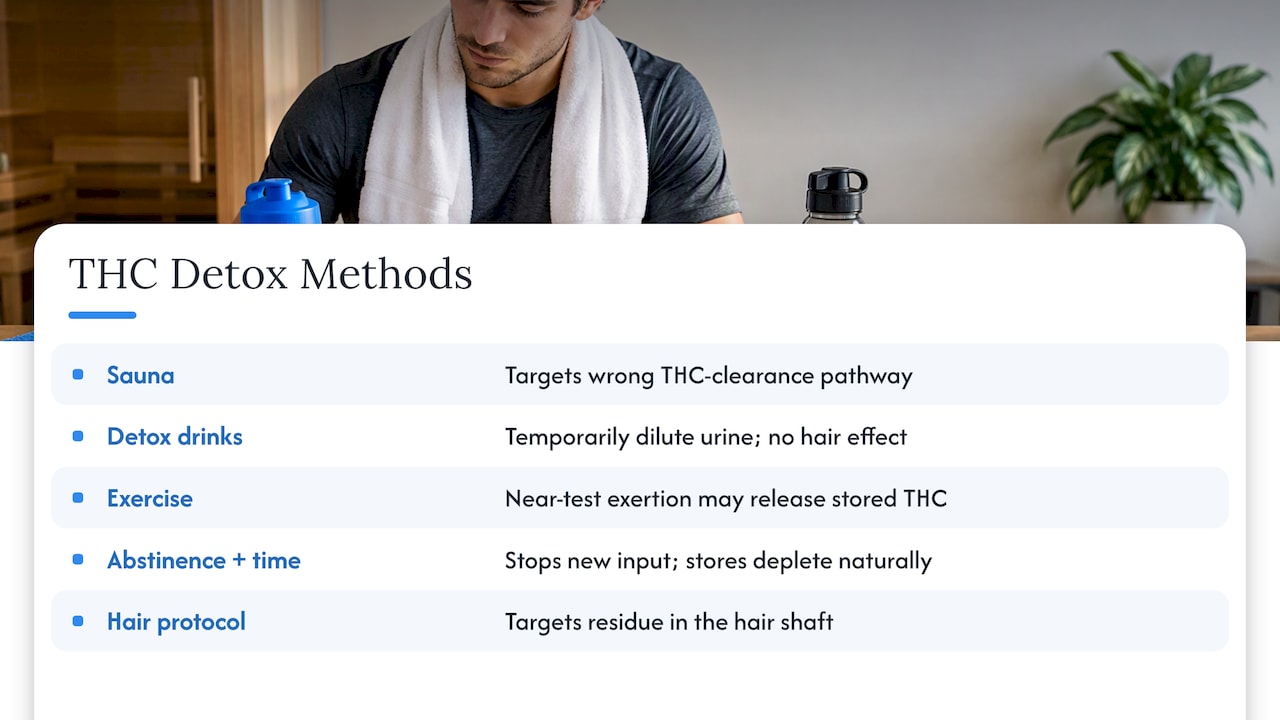
Stacked against other common approaches, sauna sessions rank low on direct effectiveness for THC clearance specifically because they target the wrong pathway. Detox drinks work by temporarily diluting urine and adding substances meant to mask metabolite detection at the moment of testing, which is a short-term, test-specific tactic rather than a change in actual THC levels, and it does nothing for hair testing at all, a point our own evaluation of detox drinks breaks down in more detail.
Dietary changes and increased water intake can support general health and modestly affect urine concentration, but they do not accelerate hepatic metabolism of THC into THCCOOH. Exercise sits in an odd spot: moderate, sustained activity over weeks can support fat loss, which indirectly affects how much THC is stored, but exertion close to test time can backfire by releasing stored THC into the bloodstream.
Abstinence paired with time remains the only approach with a clear, direct mechanism, since it removes new THC input and lets existing stores deplete naturally. For hair specifically, a validated decontamination and cleansing protocol addresses what time alone cannot reach quickly, which is residue already incorporated into the hair shaft. Saunas simply are not built to do what detox drinks, dietary adjustments or targeted hair protocols are each individually designed to do.
Why individual factors limit sauna detox effectiveness
Even if sauna use had a meaningful effect on THC clearance, which the evidence does not support, individual biology would still determine how much it mattered. Body fat percentage is the most important variable: since THC stores in fat tissue, someone with higher body fat typically has a larger reservoir of stored THC and a longer window before it fully clears, regardless of how much they sweat.
Metabolic rate affects how quickly the liver processes THC into THCCOOH for excretion. Two people with identical use patterns can clear THC at noticeably different speeds based on liver enzyme activity, overall metabolism and frequency of use. Someone who uses cannabis daily for months builds up a much larger fat reservoir than an occasional user, which means their detection window stretches out regardless of lifestyle interventions layered on top.
Hydration status, genetics and even hair characteristics for hair testing (thickness, treatment history, growth rate) all add further variability. None of these factors are things a sauna session changes. They are structural facts about your body that determine your baseline timeline, which is why abstinence duration and matrix-specific preparation matter far more than any single heat-based intervention.
Using sauna sessions safely within a broader detox plan
Sauna use can still have a place in an overall wellness routine while you are preparing for a test, as long as you are honest about what it is and is not doing. It supports relaxation, circulation and general well-being, but it should never replace the two things that actually matter: stopping use early and following a matrix-specific preparation protocol.
If you choose to use a sauna during this period, keep sessions moderate rather than intense, stay well hydrated with water and electrolytes, and avoid stacking sauna heat with intense exercise in the days close to your test, since exertion can temporarily elevate detectable THC. Treat the sauna as a stress-reduction tool that supports the rest of your plan rather than a clearance method on its own.
The protocol that actually moves the needle is built around timeline: abstain as early as possible, verify progress with at-home testing, and layer in matrix-specific preparation, whether that is a documented hair-washing protocol, hydration-based urine prep, or oral rinse routines for saliva testing, in the days leading up to your test.
Repeated sauna sessions versus a single session
Neither a single sauna session nor a repeated weekly routine produces a reliable reduction in THC levels, because the limiting factor is release of THC from fat tissue and subsequent liver metabolism, not cumulative sweat output. A single session mainly causes short-term water loss. Repeated sessions over days or weeks might support general fat metabolism as part of broader lifestyle changes, but that is an indirect, slow effect tied to overall body composition change, not a direct detox mechanism tied to the sauna itself.
The large residential-program evaluation of repeated sauna regimens studied outcomes over extended treatment periods for protracted chemical exposure, not rapid pre-test clearance, and even then the benefits were framed as general health improvements rather than measured THC elimination speed. For someone with a test in days rather than months, repeating sauna sessions will not compress a multi-week elimination timeline into a shorter one.
A practical perspective on realistic expectations
Hair tests track use over a long window, and no amount of sweating changes that math. What we have seen work is pairing early abstinence with a documented, matrix-specific protocol rather than chasing shortcuts that sound plausible but do not hold up against how THC actually moves through the body. Our hair-cleansing products are part of a process, not a replacement for one. If your situation is urgent or complicated, a case-specific consultation is worth more than general advice.
— Detox Experts
Matching PassUSA products to your test type and timeline
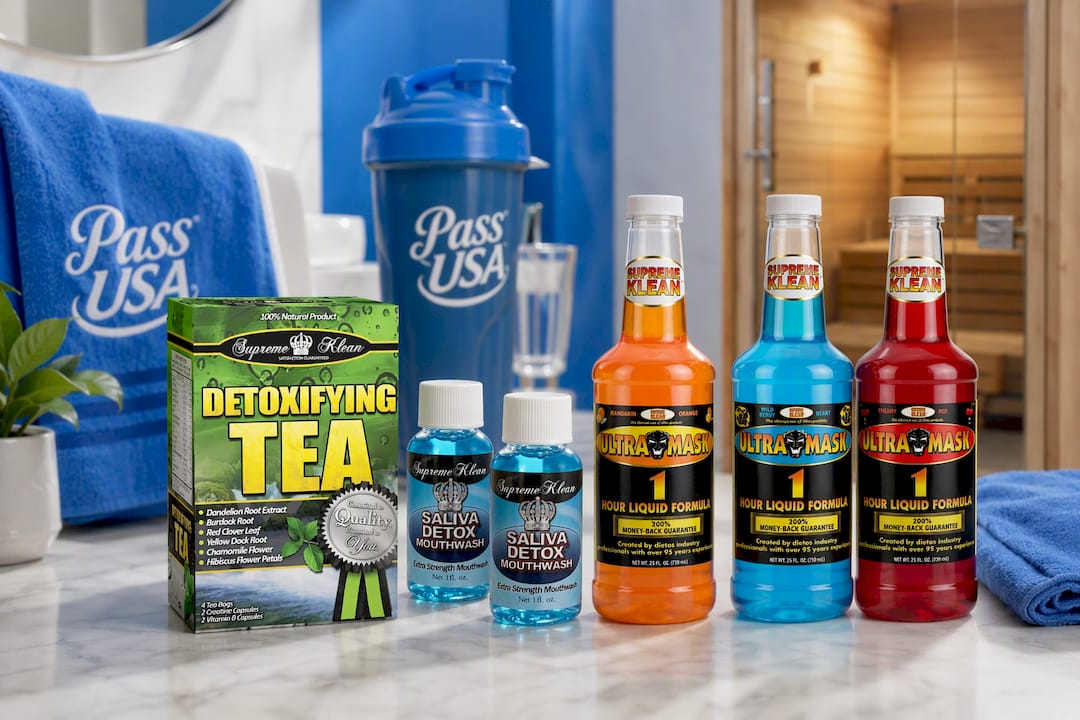
We built our product lineup around the test you are actually facing, since hair, urine and saliva each demand a different approach. For hair, our hair-cleansing guidance pairs the Macujo Method with structured shampooing. For oral fluid, our Macujo Saliva Detox Mouthwash is one option for saliva-test preparation. For urine testing, our Macujo Premium Detoxifying Tea and Macujo Premium Detox Drink are among the available options.
- Hair testing: a structured, time-based protocol built around the Macujo Method.
- Urine testing: hydration-based preparation paired with full-body flush products.
- Saliva testing: a fast-acting oral rinse for same-day prep.
If your timeline is tight or your case is complicated by factors like heavy use history or an upcoming screening you cannot delay, a private consultation with Mike Macujo gives you personalized guidance built around your specific situation. Browse our full hair, urine and saliva test products to find the right starting point for your plan.
FAQ
Does a sauna help flush out toxins?
A sauna makes you sweat, but sweat accounts for less than 1% of total THC elimination, so it does not meaningfully flush THC from your system. It can support relaxation and circulation, but it is not a reliable clearance method.
How long do you sit in a sauna to detox?
There is no sauna duration that reliably clears THC, since the elimination pathway runs through liver metabolism and excretion rather than sweat. Research on sauna-based regimens for chemical exposure studied multi-week programs, not single sessions, and even those were not measured for rapid THC clearance.
How do you use a sauna for detox safely?
Use moderate sessions, stay hydrated with water and electrolytes, and avoid combining sauna heat with intense exercise close to a test date, since exertion can temporarily raise detectable THC levels. Treat it as a wellness habit alongside abstinence and matrix-specific preparation, not a replacement for either.
Can exercise before a drug test hurt my results?
Yes, intense exercise within about 48 hours of a test can release fat-stored THC into your bloodstream and cause a temporary spike in detectable levels. It is safer to avoid strenuous activity close to your test date.
What actually helps prepare for a hair follicle test?
Early abstinence combined with a documented, validated hair-washing protocol is the approach supported by hair-testing consensus standards. Our hair-cleansing guidance includes step-by-step instructions.